

In Evercold, gearing your main will no longer revolve around capping the latest named tomestones every week and visiting the same vendor for upgrades. Square Enix is introducing two upgradeable gear paths: Seasonal Adventure Gear (Seasonal Gear) for everyday play and Raid Reward Gear (Raid Gear) for players pushing high-end content. You will earn gear, improve its item level and customize it over the course of a season.
Seasonal Gear is the starting point we would recommend for most players, while Raid Gear gives Savage raiders a longer upgrade path and more control over secondary stats. The biggest changes are not just the sources of gear, but the way upgrades, materia and catch-up work. The following guide covers the system shown at the October 31 Tokyo Fan Fest and clarified in the November 5 official Q&A. Evercold is not live yet, so item levels and upgrade limits below describe the announced development plan, not final duty requirements or a day-one best-in-slot (BiS) list.
How Evercold Gearing Works
Gear Optimization is the announced system for obtaining and improving Seasonal and Raid Gear. A season spans an even-numbered major patch and the following odd-numbered major patch, such as 8.0 and 8.1. This is important because each half of the season changes which upgrade materials you can obtain and how often.
| Feature | Seasonal Gear | Raid Gear |
|---|---|---|
| Best for | Everyday play, casual endgame, Fierce preparation | Savage and long-term high-end gearing |
| Base gear source | Adventurer Activity rewards and exchanges | Eight-player Savage raid exchange items |
| Shown item levels (ilvl) | 840 → 850 | 840 → 850 → 860 |
| Upgrade sources | Fierce raids; Normal trials as an alternative in the second half | Savage exchange items; later Alliance Gear Tickets and crafted materials |
| Materia and substats | Two guaranteed slots in the shown gear | Editable substats; three unlockable advanced materia slots |
Two items at the same ilvl are not necessarily equivalent. The shown base Raid Gear and Seasonal Gear both start at 840, but they offer different stat customization and different paths to further upgrades. Nor does Gear Optimization mean that all other gear sources are disappearing. Dungeon drops, crafted items and other equipment still have a place in preparing your job for endgame.
If you are returning to FFXIV now, keep launch preparation separate from your future level 110 gear plan. A usable Dawntrail set may help you finish your remaining content, but you do not need to chase an entire Savage set just to enter the expansion.
Choose the right gear for your next goal
If you still need to gear a level 100 job before launch, compare the current options. For a purchase budget, count only the items you actually need.
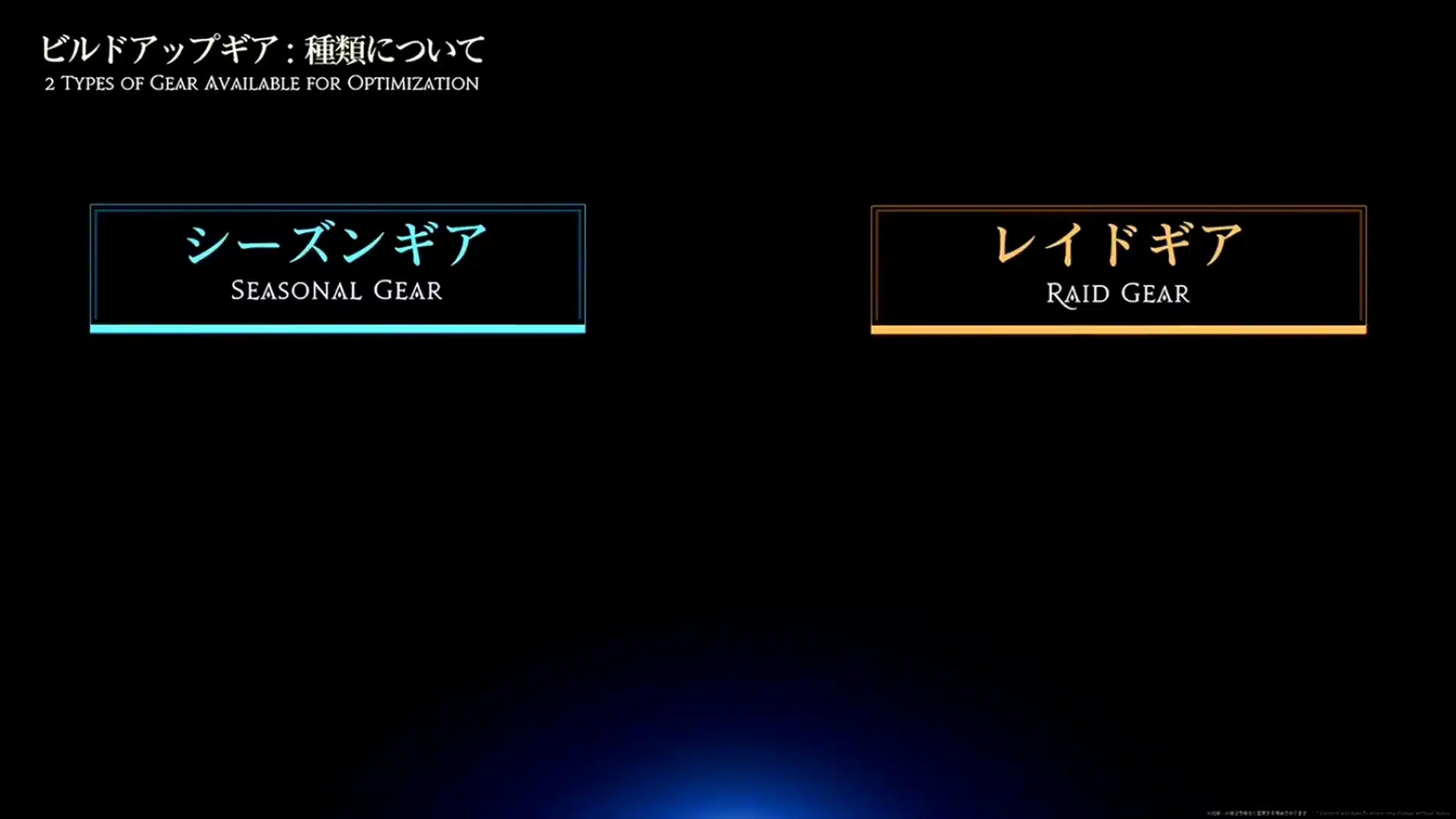
Two gear optimization paths. Tokyo keynote, 3:02:20. Development footage — Square Enix.
How to Get and Upgrade Seasonal Gear
Seasonal Gear is the route for players who want meaningful upgrades without building their entire schedule around Savage. You can also use it on a raid main while working toward other pieces. The key is to separate earning the base gear from upgrading it later: completing an eligible dungeon or quest contributes toward Activity rewards, but that does not mean every duty immediately drops a new Seasonal piece.
Activity Points, Activity Levels and Gear Exchanges
Adventurer Activity is the new seasonal reward system. Activity Points are earned by completing eligible missions, and accumulating enough of them raises your Activity Level. This is a separate measure from the level of your battle job. A level 110 job does not automatically have a completed Activity reward track.
- Open the Adventurer Activity interface and choose missions that fit what you want to play.
- Complete eligible content, such as quests, battle duties, crafting, gathering or PvP, to earn Activity Points.
- Raise your Activity Level and claim the associated rewards, including gear exchange items.
- Use the Seasonal Gear interface to exchange the appropriate items for the piece you want.
- Obtain Optimization Items from the relevant duties when you are ready to increase that piece’s ilvl.
The presentation included repeatable Standard missions, so you are not expected to play every category of content to make progress. For example, a player who prefers battle duties should look at the available battle missions first rather than assuming that crafting is compulsory. Activity Points advance the reward track; they are not a direct purchase price for each gear piece in the way older tomestones were.
When choosing a piece, look for a slot that is holding back your intended job. A fresh endgame player might prioritize a weak weapon or a large armor upgrade, depending on which exchange items are available. The new interface is designed to handle gear exchanges and optimization without repeatedly visiting a specific vendor.
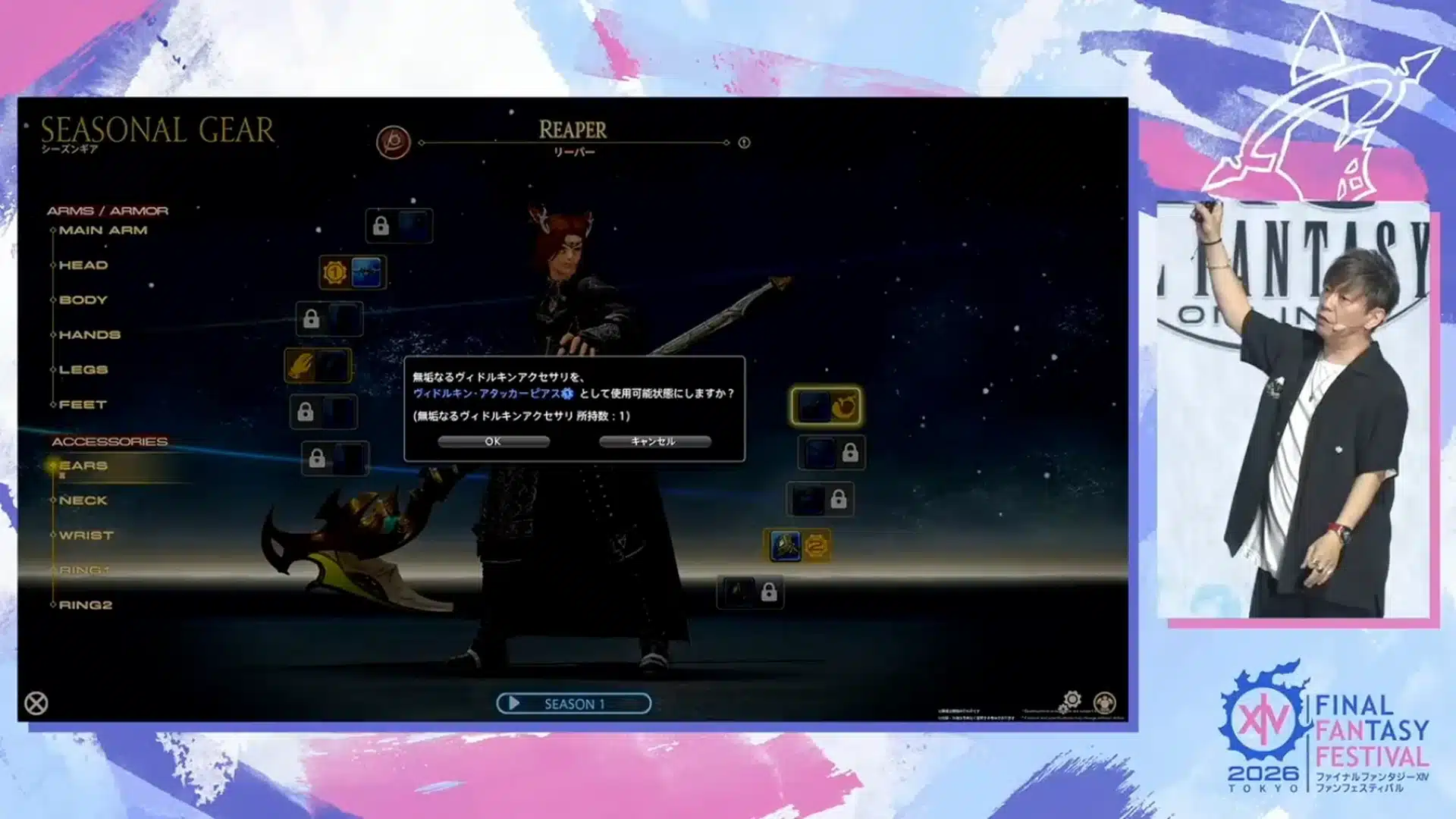
Seasonal Gear interface demonstration. Tokyo keynote, 3:05:30. Development footage — Square Enix.
Seasonal Gear Upgrades: Fierce Raids and Normal Trials
Seasonal Gear has one announced item level upgrade per season. In the development example, an unoptimized i840 piece becomes i850 when you use the required Optimization Item. Both stages retain two ordinary materia slots.
| Season phase | Optimization source | Shown allowance |
|---|---|---|
| First half (even patch) | Eight-player Fierce raids | One gear piece per week |
| Second half (odd patch) | Eight-player Fierce raids | No weekly limit on these upgrade items |
| Second half (odd patch) | Normal trials | One gear piece per week |
Fierce is the new raid difficulty between Normal and Savage. If you want to improve Seasonal Gear early in the season, it gives you a reason to try a harder eight-player duty without making Savage your goal. If you would rather play Normal content, the second half introduces a different route to the same Seasonal upgrade. Waiting for that route is a valid choice.
Do not confuse the removal of a weekly limit on Fierce optimization materials with the removal of every raid loot restriction. The slide is specifically about the materials used to improve Seasonal Gear. It does not make Savage, cosmetics or every other reward unlimited.
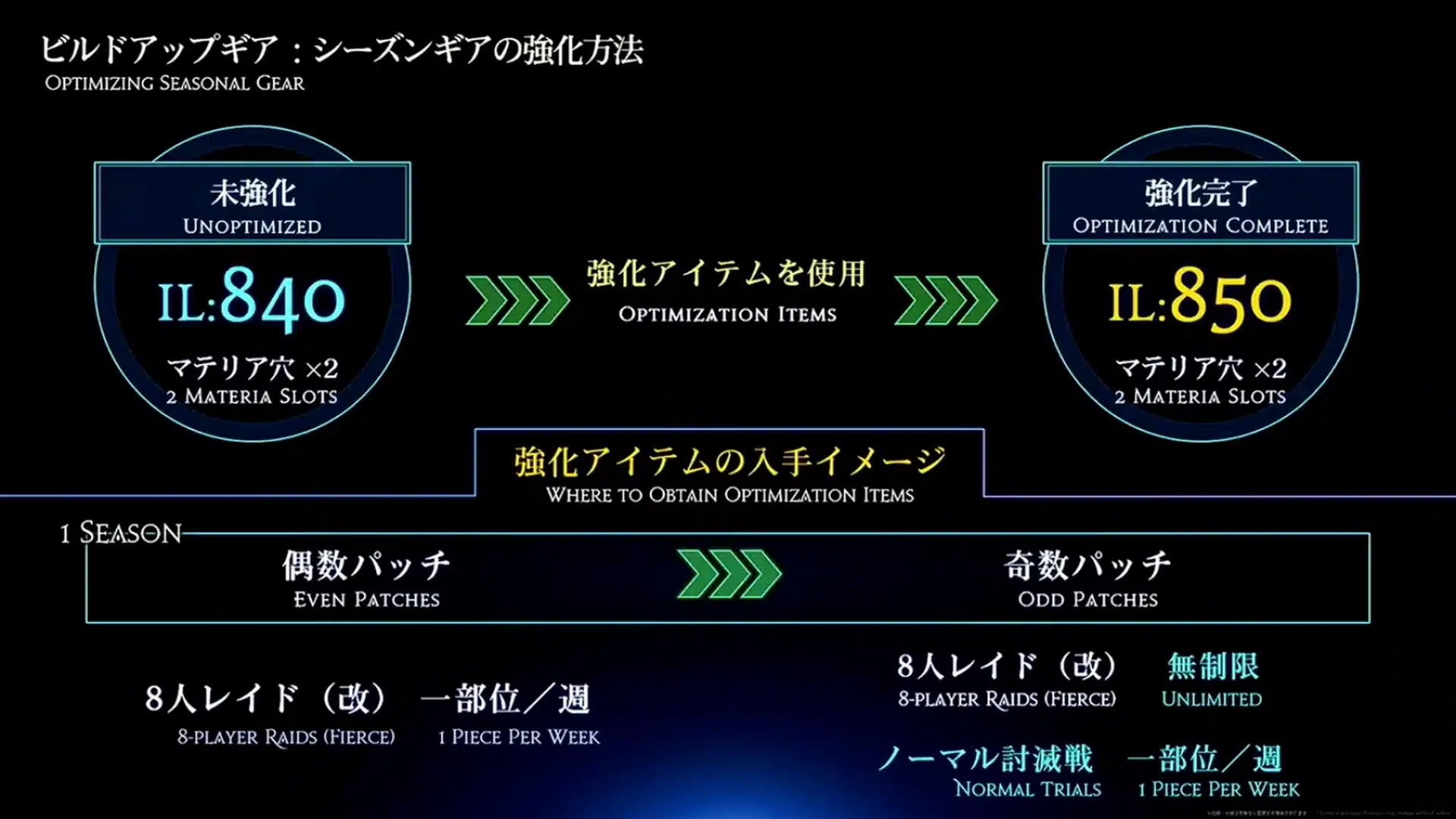
Seasonal Gear optimization and weekly limits. Tokyo keynote, 3:08:58. Development footage — Square Enix.
Weekly Activity Points and Catch-Up
One of the most useful changes for anyone with an unpredictable schedule is the announced ability to earn missed Activity Points. Rather than losing all progress from a week in which you could not play, you can complete the current week’s available points and then make up points that went unearned in the preceding week.
Imagine being away for a week and returning just before your static resumes its practice sessions. You can work toward the current Activity allowance and then continue earning the missed points, rather than being permanently behind simply because you missed a reset. That still takes actual play. The system is not an automatic gear grant, and the exact carryover rules have not been finalized publicly.
There are two independent forms of catch-up here: missed Activity Points affect your reward track, while the later removal of weekly upgrade limits affects Optimization Items. Catching up on points does not automatically complete your Fierce or Savage upgrades.
How to Get and Upgrade Raid Gear
Raid Gear is for players who want to pursue the stronger and more customizable gear available through high-end duties. Unlike the single Seasonal upgrade, the development example gives Raid Gear two ranks of optimization. Obtaining a base piece from Savage is only the start; you will also need additional exchange items and later-season materials to finish its item level progression.
Savage Personal Loot and Gear Exchange Items
The new eight-player Savage loot design replaces competition for a shared set of coffers with individual rewards. The Tokyo keynote showed personal coffers containing exchange items, which you can use in the gear interface to obtain pieces. Different raid floors have different exchange items, so one clear of the first floor does not give you access to every item in the set.
This is especially welcome for players who raid through Party Finder (PF) or who have friends at different stages of progression. In the November 5 Tokyo Q&A, Yoshida clarified that players who have already completed their weekly clear can help others without reducing the eligible players’ individual coffer rewards.
For instance, if half the party has already cleared and the other half still qualifies for weekly loot, the eligible half can all receive their personal reward under the announced design. This does not mean the helpers receive another weekly coffer themselves. For a static, the change should reduce the need to organize groups around who still has loot eligibility. For PF players, it should make getting help with a clear less complicated.
Raid Gear Upgrades Across the Season
The item level shown for the Raid Gear path is 840 → 850 → 860. The first rank uses further Raid Gear exchange items from Savage. The second rank requires Alliance Gear Tickets from a new eight-player Alliance Raid (Savage) together with crafted materials. The latter is a separate high-difficulty activity based on alliance raid content, not the regular 24-player Alliance Raid.
| Stage | Material source | Announced weekly rule |
|---|---|---|
| 840 → 850, even patch | Eight-player Savage exchange items | Once per week per floor |
| 840 → 850, odd patch | Eight-player Savage exchange items | No weekly limits on this route |
| 850 → 860, odd patch | Eight-player Alliance Raid (Savage) tickets plus crafted materials | Once per week per floor for the raid source |
For the first half of the season, the practical goal is to clear the floors you need, exchange for base gear and decide how to spend later eligible rewards on improvements. In the second half, players who started late can catch up on the first optimization rank more freely, while established raiders can work toward the second rank.
The presence of crafted materials also means crafting still matters. Your group may want a crafter or a budget for Market Board purchases, even if the upgrade starts with a raid-earned item. The precise recipes and amounts are not yet public, and neither gil nor extra clears can be assumed to replace the relevant weekly ticket requirement.
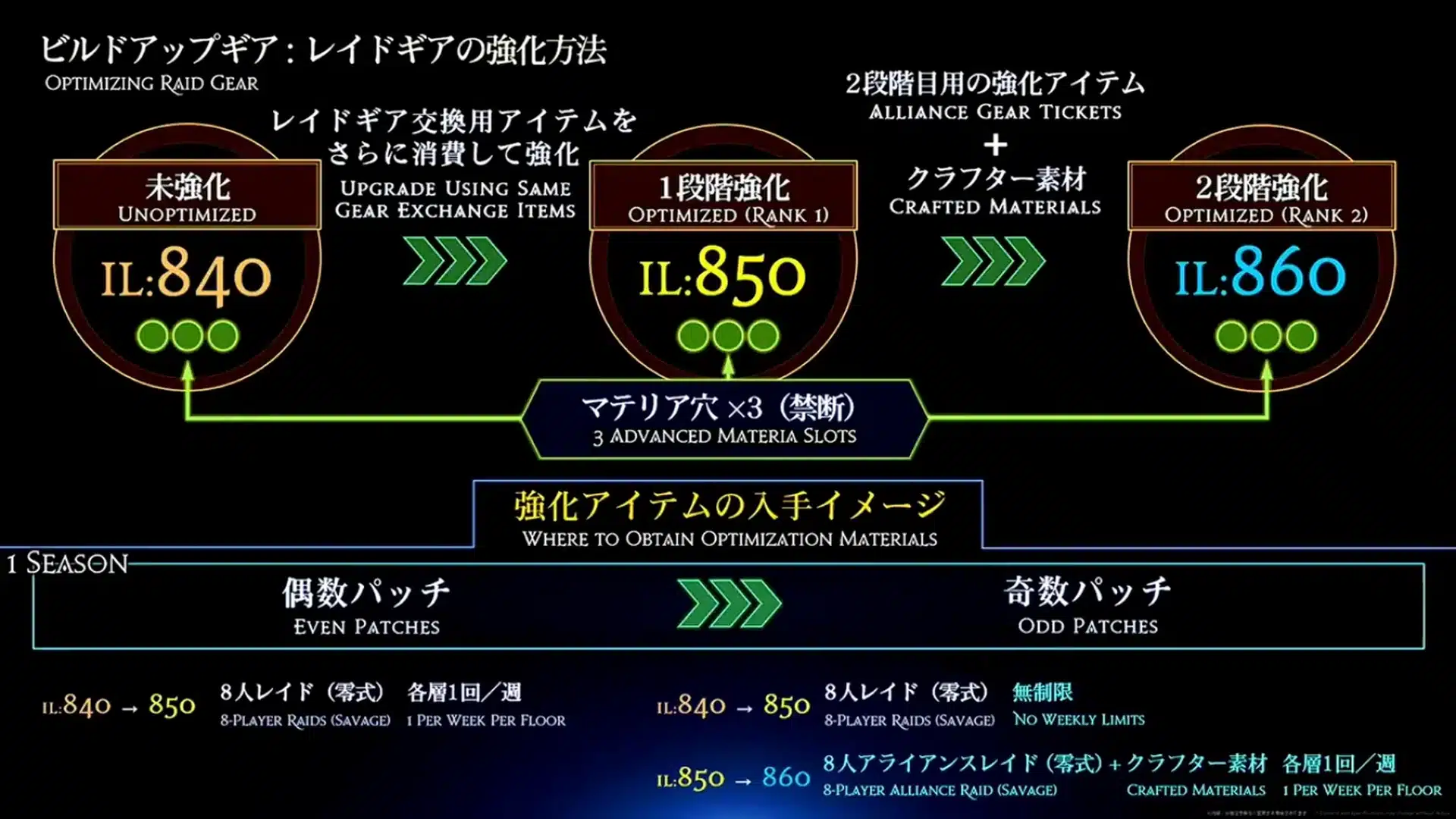
Raid Gear optimization across a season. Tokyo keynote, 3:19:07. Development footage — Square Enix.
Master Gear and Customizable Weapon Effects
Optimizing the full Raid Gear set has an additional reward beyond higher stats. The keynote demonstrated unique visual effects (VFX) for the weapon once a complete job set is fully optimized. The presentation described a Master state and showed ways to select or turn off weapon effects.
This makes finishing your set an attractive long-term glamour goal as well as a gearing goal. The effect is not a new Ultimate weapon or a reward for a single Savage clear. You are working toward a completed optimization path for a specific job, with the exact eligibility rules tied to the final version of the system.

Weapon effects for completing gear optimization. Tokyo keynote, 3:20:35. Development footage — Square Enix.
How Materia and Substats Change in Evercold
Materia is not going away. What changes is how the two gear paths use it. A meld is the process of adding materia to a compatible piece of gear to improve a stat. In Evercold, the shown Seasonal equipment keeps its ordinary slots, while Raid Gear starts with adjustable secondary attributes (substats) and can gain advanced slots separately.
Seasonal Gear: Two Guaranteed Materia Slots
In the Tokyo example, Seasonal pieces have two guaranteed materia slots both before and after the upgrade from i840 to i850. That is the familiar part of the new system: choose melds that fit your job’s needs and the stats already available on the piece.
For example, a caster might want to reach a particular Spell Speed target before spending the rest of their melds on other useful stats. That target depends on the job and its final rotation; there is no universal stat order for every job in 8.0. The two guaranteed slots also do not establish a five-slot pentamelding route for Seasonal Gear.
Raid Gear: Editable Substats and Sealed Advanced Slots
Base Raid Gear has no guaranteed materia slots in the shown system. Instead, its secondary attributes can be edited and are set at a level equivalent to filling normal materia slots for that item level. That gives raiders more direct control over how their gear supports a specific job, without treating the absence of ordinary sockets as a loss of all stat customization.
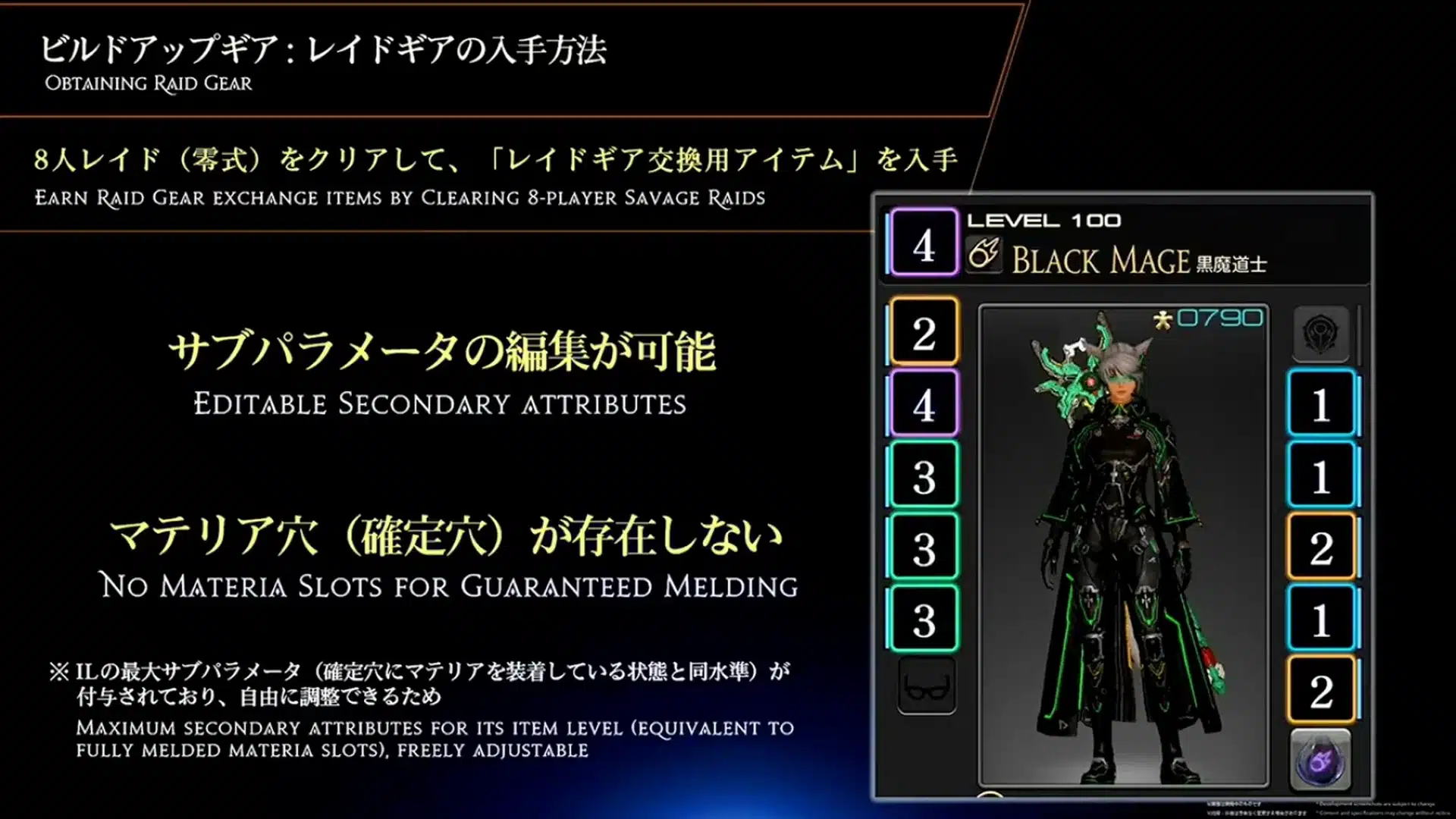
Editable secondary attributes on Raid Gear. Tokyo keynote, 3:14:05. Development footage — Square Enix.
Three separate actions matter for Raid Gear:
- Choose your substats. Use the editable secondary attributes to build around the job you are actually playing.
- Open three advanced materia slots. The development plan includes a separate item earned through Adventurer Activity to unlock these slots, independently of the item’s optimization rank.
- Perform advanced melds. The developers showed support for the strongest current materia and a higher success rate than conventional advanced melding. A higher chance is not a guaranteed success.
These changes mean an i840 Raid piece is not identical to an i840 Seasonal piece just because both have the same item level. They differ in how you choose their stats and how much further you can customize them. You can work on unlocking slots without confusing that task with earning the next i850 or i860 upgrade.
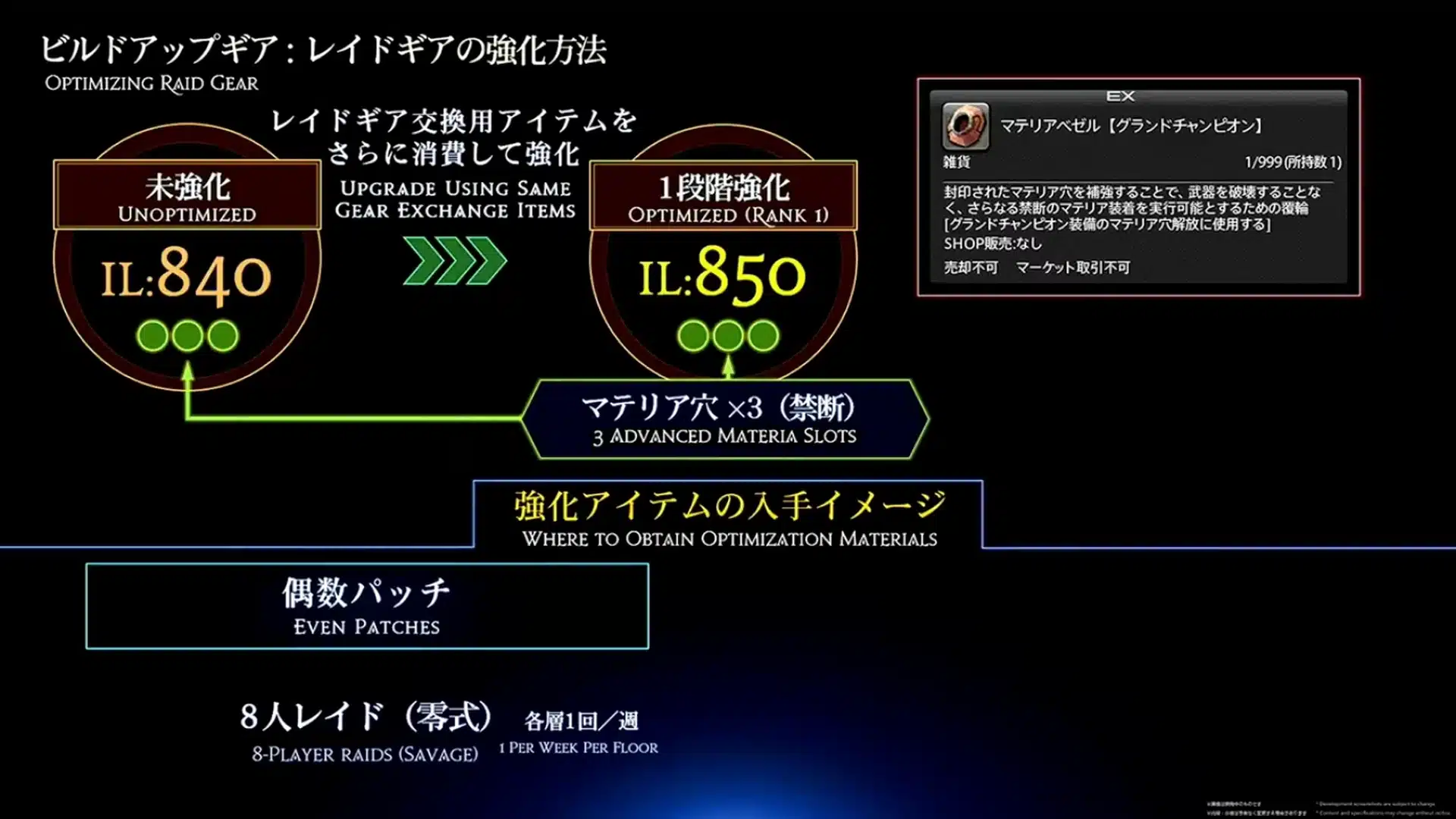
Advanced materia slots on Raid Gear. Tokyo keynote, 3:17:50. Development footage — Square Enix.
Our recommendation is to avoid committing a large materia budget to the expansion based on Dawntrail’s pentamelding costs. The final materia grades, success rates and ideal job-specific stat distributions will determine how much you actually need. Buy for a specific purpose rather than assuming every old stockpile will be useful.
Are Tomestones Going Away? Gearing Your Other Jobs
No, not all Allagan tomestones are disappearing. Activity Points and Activity Level will take over the main seasonal reward path. The official Tokyo Q&A confirmed that Allagan Tomestones of Poetics are being removed and the separate named tomestone varieties are going away. However, a general Allagan tomestone currency will remain as a flexible way to obtain items such as Seasonal Gear for additional jobs.
This distinction matters if you enjoy switching between roles. You should not have to rely entirely on the same initial Activity reward progression to outfit every other job. At the same time, the announcement does not specify how old balances will convert, the future currency cap or the exact cost of each alt-job piece.
Keep an inventory of useful shared gear and decide which job you want to prioritize. Switching between Reborn and Evolved on the same existing job is different from gearing an entirely different job: the two modes share that job’s gear and level.
Which Gear Should You Aim For in Evercold?
The best gearing route depends on what you plan to do at level 110. If you are still leveling, focus on suitable leveling equipment and completing the required story and unlocks before committing to an endgame set. Here is how we would approach the announced paths once they become available.
| Your goal | Start with | Next useful upgrade | No need to rush |
|---|---|---|---|
| Story and ordinary endgame | Seasonal Gear | Activity rewards and later Normal trial upgrades | Savage optimization |
| Try Fierce raids | Seasonal Gear | Early Fierce Optimization Items | Full Raid Gear just to try Fierce |
| Savage and high-end prog | Suitable entry gear and eligible Seasonal pieces | Base Raid Gear, first optimization and stat choices | Second-half rank before its source opens |
| Play several jobs | Prioritize your main and useful shared pieces | Seasonal exchanges and general tomestones for additional jobs | Max optimization for every job |
For a Savage main, don’t ignore useful Seasonal pieces while you are waiting for a particular raid exchange item. And if you primarily play trials and roulettes, you do not need to turn the end of every season into a raid checklist. The final entry requirements for individual Evercold duties and the exact BiS combinations will depend on the released gear and encounter rules.
Plan Your Evercold Gearing
Choose a main and a realistic endgame goal before investing in every upgrade. Check your current pieces, identify the materials and consumables you actually need, and separate things you can earn through Activity or raids from items you can buy. Keep a reserve of gil for the first season rather than spending everything on a set that you will soon replace.
If your plan includes buyable crafted materials, food, potions or materia, calculate the cost on your World and subtract the gil you already have available. FFXIV Gil is an option for covering that shortfall. It cannot replace raid tickets, Activity Points or weekly loot eligibility. The important thing is to spend your time and budget on upgrades that support the content you actually want to play.


