
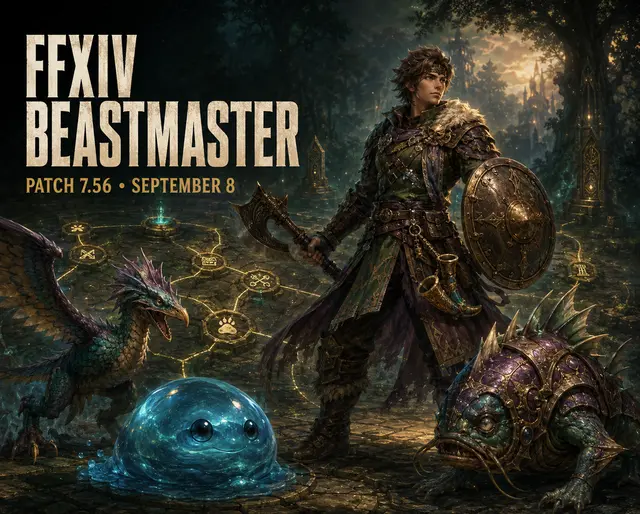
FFXIV Beastmaster releases on Tuesday, September 8, 2026, with Patch 7.56. It will be the game’s second limited job after Blue Mage: a melee DPS that starts at Level 1, caps at Level 50, collects 50 beasts, and rotates three pets through Battlehorns. Its main solo activity is the Crucible of the Unbroken, where enemy weaknesses, pet health, Feed, and route choices matter as much as the normal combat rotation.
This FFXIV Beastmaster job guide covers the launch requirements, pet system, Borrow and Tempered Release actions, Instinctual Combos, Beast Ranks, and the Crucible of the Unbroken. The information comes from the Patch 7.5 presentations and the Beastmaster demonstration during Letter from the Producer LIVE Part XCIII at Fan Festival 2026 in Berlin.
Current data: Patch 7.56 pre-release information, reviewed August 8, 2026. Square Enix can still change action names, potencies, cooldowns, rewards, and duty restrictions before September 8. Check the official Patch 7.5 site and final Patch 7.56 notes for launch-day changes.
FFXIV Beastmaster Release Date and Job Overview
| Beastmaster Detail | Patch 7.56 Information |
|---|---|
| Release date | September 8, 2026 |
| Patch | Patch 7.56, the final part of Dawntrail’s Patch 7.5 series |
| Job type | Limited job |
| Role | Melee DPS |
| Weapon | One-handed axe and shield |
| Starting level | Level 1 |
| Initial level cap | Level 50 |
| Launch collection | 50 tameable beasts |
| Combat loadout | Three Battlehorns, with one active beast at a time |
| Exclusive duty | Crucible of the Unbroken, unlocked through Beastmaster job quests at Level 30 |
Want a character ready before Patch 7.56? Finish your selected MSQ, level a combat job, collect gear, or clear other FFXIV content before Beastmaster releases.
What Kind of Job Is Beastmaster in FFXIV?
Beastmaster is a limited melee DPS job built around captured pets rather than a fixed raid rotation. The player carries an axe and shield, but much of the kit changes with the beast on the field. Every pet has its own auto-attack type, stats, Instinctual Skill, and Tempered Release action. Its family also decides which action the Beastmaster receives through Borrow.
The limited-job label matters. Beastmaster is not being added as another standard melee for current Savage raids, daily roulettes, or normal endgame party compositions. It has separate progression rules and its own solo duty. Square Enix has not published the complete launch restriction list yet, so the Patch 7.56 notes will be the final source for which regular duties Beastmaster can enter.
Beastmaster also plays differently from Blue Mage. Blue Mage learns enemy spells and equips a personal spell set. Beastmaster captures full creatures, assigns three of them to Battlehorns, and swaps the active pet as horns enter and leave cooldown. The collection is part of the combat system, not a cosmetic list sitting outside it.
How to Unlock Beastmaster in FFXIV
To unlock FFXIV Beastmaster on September 8, your service account must have Dawntrail registered. Your character must also have one Disciple of War or Magic at Level 50 and must have completed the A Realm Reborn 2.0 main scenario.
| Requirement | What You Need |
|---|---|
| Expansion license | FINAL FANTASY XIV: Dawntrail registered to the service account |
| Combat job | Any Disciple of War or Magic at Level 50 or higher |
| Main Scenario Quest | A Realm Reborn 2.0 MSQ completed |
| Beastmaster starting level | The job starts at Level 1 after it is unlocked |
The exact unlock quest name, NPC, and coordinates were not given in the Berlin presentation. The official Patch 7.5 site places the Beastmaster story in the Black Shroud, but it does not identify the starting NPC. Any page listing a specific quest giver before the 7.56 notes is treating an unconfirmed detail as final.
How Beastmaster Captures Pets
Beastmaster adds captured creatures to the Master’s Bestiary. The earlier Patch 7.5 demonstration broke taming into three actions: Gauge, Weaken, and Catch. Gauge checks whether the target is tameable. Weaken improves the capture chance as the enemy loses health. Catch makes the capture attempt.
You do not need to compete with another Beastmaster for ownership of a target. Captures are resolved separately for each player, and Square Enix said players can tame as a group. Beasts connected to group content will still have a solo acquisition route during the initial release, so completing a large raid should not be required to fill the launch Bestiary.
Level matters during taming. A Beastmaster will have a harder time catching a creature above their own level. Level the job as you work through the Bestiary instead of trying to capture every Level 50 target on the first evening.
Master’s Bestiary Information
The Master’s Bestiary records each captured beast and the details needed to build a loadout. The preview pages included the beast’s number, name, classification, rank, stats, auto-attack damage type, Trick action, Tempered Release action, appearance, and Satiety slots.
Captured beasts can follow the player through towns and public areas. Their display size has three settings, so a large pet can be reduced before it blocks an NPC or fills half the screen. Max-rank appearances also remain visible outside the Crucible.
Interested in completing the full collection? See our FFXIV Master’s Bestiary Boost to catch all 50 beasts or finish only the entries you are missing.
How Battlehorns and Pet Swapping Work
A Beastmaster equips three pets by assigning one to each Battlehorn. Only one pet fights at a time. The other two stay ready for the next swap. This gives the job a three-pet combat loadout without placing three independent companions on the field.
Battlehorn actions have no cooldown outside combat. You can call different pets, set up a Borrow action, and put the intended opener on the field before a pull. In combat, sending a pet away with Parting Blow starts that horn’s cooldown. The job then moves to the next available beast.
The order should be planned before combat. One pet may supply an interrupt through Borrow, another may lock enemies in place through Tempered Release, and a third may carry the correct physical or elemental damage for the target. Picking three favorite models without reading their actions leaves much of the job unused.
FFXIV Beastmaster Actions Explained
| Action | What It Does | How It Is Used |
|---|---|---|
| Trick | Orders the active beast to use its Instinctual Skill. | Pairs with a Beastmaster Instinctual Skill to create a combo. |
| Tempered Release | Orders the active beast to perform its individual special action. | Provides one of 50 pet-specific effects at launch. |
| Borrow | Takes a classification-based action from the active beast for the Beastmaster to use. | Provides one of eight Borrow actions and stays set after the active pet changes. |
| Parting Blow | Commands a large area attack, then returns the pet to its Battlehorn. | Finishes that pet’s field time and starts the Battlehorn cooldown. |
| Rally | Refills the Beastmaster’s TP gauge. | Extends an Instinctual Combo sequence when the player’s gauge is empty. |
| Rallying Cheer | Refills the active beast’s TP gauge. | Lets the pet use another Instinctual Skill without waiting for normal TP generation. |
One with Nature: Borrow or Tempered Release
Summoning a pet grants one charge of One with Nature. That charge can be spent on Borrow or Tempered Release. Using one removes the chance to use the other for that summon, so each Battlehorn call creates a real choice: take the family action for yourself, or order the pet to use its personal special attack.
A Borrowed action remains available after you change pets. It is replaced when Borrow is used again. This allows an interrupt or ranged attack to be prepared before combat, followed by a different pet whose Tempered Release or Instinctual Skill fits the pull.
Beastmaster Borrow Classifications
The 50 launch pets belong to eight classifications. Borrow cares about the classification, not the individual creature. Two Wavekin may have different Tempered Release and Trick actions, but both feed the Wavekin Borrow slot.
| Classification | Borrow Information from the Preview |
|---|---|
| Beastkin | Beastskin was used as a defensive effect to reduce incoming damage. |
| Wavekin | Quelling Wave supplied a repeatable long-range attack. |
| Vilekin | Has its own family action; final tooltip details should be checked in Patch 7.56. |
| Scalekin | Supplies the classification-based Scaleskin action. |
| Cloudkin | Has its own family action; final tooltip details should be checked in Patch 7.56. |
| Soulkin | Soul Crush interrupted an enemy cast and showed 1,000 potency in the development build. |
| Seedkin | Has its own family action; final tooltip details should be checked in Patch 7.56. |
| Ashkin | Has its own family action; final tooltip details should be checked in Patch 7.56. |
The demo gave a clean example of why this system exists. Borrowing Quelling Wave from a Pugil produced a ranged attack. The player then used a Slime’s Syrup to apply Bind+, a bind that did not break when the enemy took damage, and attacked from outside melee range. Later, Soul Crush from a Coblyn stopped a Bomb’s Explosion cast.
Tempered Release Examples
| Beast | Tempered Release | Effect Shown Before Release |
|---|---|---|
| Slime | Syrup | Area damage and Bind+, which remained after the target took damage. |
| Ziz | Petra Breath | Area damage with Petrification. |
| Cu Sith | Relentless Rake | Six instances of single-target physical damage. |
These are examples, not a best-pet list. The right action changes with the target. A hard bind has little value against an immune boss, while an interrupt can decide a fight built around one dangerous cast.
FFXIV Beastmaster Rotation and Instinctual Combos
Beastmaster and the active pet have separate TP gauges. Normal actions and pet attacks build those resources. TP is then spent on Instinctual Skills: four on the Beastmaster side and one tied to each pet.
Using a player Instinctual Skill and a pet Instinctual Skill in succession creates an Instinctual Combo. Any valid pair deals bonus damage. The better version follows the affinity wheel clockwise and is called an Intentional Combo.
| Affinity | Gauge Color | Beastmaster Skill Shown | Next Clockwise Affinity |
|---|---|---|---|
| Volant | Green | Gale Axe | Rampant |
| Rampant | Red | Avalanche Axe | Durant |
| Durant | Blue | Mistral Axe | Eldritch |
| Eldritch | Brown | Spinning Axe | Volant |
Suppose the active pet uses a blue Durant Trick action. The next step clockwise is brown Eldritch, so Spinning Axe completes the Intentional Combo. Starting with red Rampant means the next action should be blue Durant. The direction stays the same regardless of whether the Beastmaster or the pet opens the pair.
Sun Strider and Moon Stalker
Successful clockwise pairs also fill the center of the job gauge with Sun Strider or Moon Stalker. The Berlin build displayed a white Sun Strider state and a black Moon Stalker state, based on which side of the pair acted first. These temporary states feed the Level 50 combo flow and reward alternating between player and pet actions instead of pressing one side whenever TP appears.
Rally fills the player’s gauge and Rallying Cheer fills the pet’s gauge. Save them for the side that would otherwise break the clockwise chain. A long run of correct pairs raises the combo count and increases the payoff shown in the demo.
A Practical Beastmaster Combat Loop
| Step | Action | Reason |
|---|---|---|
| 1 | Prepare Borrow before the pull | Battlehorns have no cooldown outside combat, so the opening borrowed action can come from a pet that does not stay active. |
| 2 | Call the first planned pet | Its auto-attack type, Trick affinity, and Tempered Release should match the enemy. |
| 3 | Build both TP gauges | The player and pet each need resources for their Instinctual Skills. |
| 4 | Pair affinities clockwise | A clockwise pair becomes an Intentional Combo and deals more damage than an unordered pair. |
| 5 | Use Rally or Rallying Cheer | Refill the side needed to continue the current combo order. |
| 6 | Spend One with Nature | Choose Borrow for the family action or Tempered Release for the individual pet action. |
| 7 | Finish with Parting Blow | Deal area damage, return the pet to its horn, and move to the next pet while the horn cools down. |
This is a framework, not a fixed opener. Enemy immunities, a needed interrupt, pet TP, and the next available Battlehorn can all change the order. Beastmaster is built for adjustments during a fight rather than one memorized two-minute script.
Beastmaster Pet Stats, Rank, and Feed
Pets have their own combat stats inside the Crucible of the Unbroken. Beast Rank raises those values, while Feed modifies a selected creature for the current run. A pet with high physical Strength is not automatically better than a magical pet if the next enemy has low Magic Resistance.
| Pet Stat | What It Controls |
|---|---|
| Strength | Physical damage dealt by the pet. |
| Intelligence | Magical damage dealt by the pet. |
| Physical Resistance | Damage taken from physical attacks. |
| Magical Resistance | Damage taken from magical attacks. |
| Constitution | Maximum pet HP. |
| Satiety | The number of Feed slots available on that creature. |
Feed works like temporary pet equipment. The Berlin build included effects such as Critical Hit Rate +35%, physical damage +20%, maximum HP +50%, damage taken -20%, HP recovery, and a chance to gain Haste after taking damage. Those numbers came from a development build and should not be used for final spreadsheets until Patch 7.56 is live.
Satiety creates a tradeoff between base strength and growth during a run. Some classifications have more Feed slots than others. The Slime shown in the presentation had five slots, while smaller insects had fewer. A weaker starting pet can become the right boss pick after several good Feed purchases.
Crucible of the Unbroken Guide
Crucible of the Unbroken is Beastmaster’s solo roguelike duty. It opens through the Beastmaster job quest line at Level 30. A run begins with enemy research and a larger roster of roughly 10 to 15 beasts selected from the 50-pet collection. Each individual battle then uses three of those pets through the normal Battlehorn system.
The duty is presented as a tabletop Board with branching paths. You can take a harder route for more fights and loot or move toward recovery and the boss. HP does not refill automatically between battles. A knocked-out pet cannot be used again until recovered, which turns health into a resource across the full Board.
Interested in clearing the Crucible? See our FFXIV Crucible of the Unbroken Boost for selected Degree clears and Crucible progression.
Crucible of the Unbroken Board Nodes
| Board Node | What Happens |
|---|---|
| Normal Battle | Fight a standard enemy group and receive Territory Tokens, Crucible items, or Beast Gear after the win. |
| Tent | Restore the Beastmaster’s HP and heal a limited number of pets. The demo allowed two pets to recover. |
| Treasure | Choose one item from four random Beast Gear options. |
| Elite Battle | Fight a stronger enemy encounter for better run progress and loot. |
| Shop | Spend Territory Tokens on Crucible items, Beast Gear, and Feed. |
| Boss | Fight the final encounter using the pets, items, Feed, and health left from the route. |
Enemy Weaknesses and Team Selection
The Board reveals the enemies before the run and lists physical damage, elemental, and status weaknesses. A creature may be weak to piercing attacks, fire magic, Slow, Silence, or Blind. Resistance values are also visible, so low Magic Resistance can be attacked even when an elemental weakness is not present.
Use those pages before choosing the roster. The demo selected fire and piercing pets for a Board whose bosses were weak to those types. Another enemy used Poison, so an Angel Robe with 100% Poison Resistance removed that problem. The game can recommend a roster automatically, which gives new players a workable starting point before they learn every Bestiary page.
Two Crucible duty actions control enmity. Snarl makes the active pet take the enemy’s attention. Challenge puts the Beastmaster at the top of the enmity list. A durable pet can tank while the player attacks from range with Borrow, or the player can take hits to protect a fragile damage pet.
Crucible Items, Beast Gear, and Feed
| Item Type | How It Works | Examples from the Demo |
|---|---|---|
| Crucible Items | Consumable duty tools used for recovery, protection, or a one-time effect. | Pet healing potion, Temporal Sand battle restart, Tome of the Impervious with five physical Blink stacks. |
| Beast Gear | Passive run items that take effect when acquired rather than being equipped to one pet. | Angel Robe for Poison immunity and regeneration; Ring of Sacrifice to revive the player by sacrificing the active pet. |
| Feed | Placed into a specific pet’s Satiety slots to alter its stats or add effects for the run. | Physical damage, Critical Hit, maximum HP, damage reduction, healing, and Haste effects. |
Feed was sold at Shop nodes in the Berlin demo. Do not spend every Territory Token on early healing if the final boss needs a pet to reach a specific damage or survival threshold. Check the boss page first, then decide which creature deserves the Feed slots.
Beast Rank and Alternate Pet Appearances
Pets earn experience from Crucible results even when the run ends in defeat. Beast Rank increases their Crucible stats and caps at Rank 25 in Patch 7.56. Reaching max rank unlocks an alternate appearance for eligible pets. Some changes go beyond a simple recolor, and the selected look remains active when the pet follows you outside the duty.
Normal runs are enough to raise Beast Rank. First, Second, and Third Degree are optional challenge settings, not a gate placed in front of the alternate pet appearances.
Crucible Degrees and Ranked Seasons
Clearing all normal Boards unlocks First Degree, Second Degree, and Third Degree. Higher Degrees raise enemy HP and damage. Third Degree is the ranked mode and expects better use of enemy data, Feed, Beast Gear, health recovery, and pet combinations.
The ranked challenge is not meant to copy Savage or Ultimate. Its difficulty comes from preparation, route decisions, and combining effects across a run. Season 1 begins September 24, 2026 and continues until Patch 7.58. Crucible Ranking Scores are compiled from the last three attempts of each board, with rankings aggregated per physical data center.
Players who finish in the Top 300 of their physical data center receive the Crucible Contender achievement and Tourmaline Golem mount reward after the season ends.
Interested in the ranking mount? See our FFXIV Tourmaline Golem Mount Boost for a Top 300 Crucible Rankings finish.
Crucible of the Unbroken Rewards
| Reward | How It Is Earned or Used |
|---|---|
| Beastmaster EXP | Awarded from Crucible results and used to level the job toward the initial Level 50 cap. |
| Beast EXP | Raises the ranks of pets brought into the Crucible, including after failed runs. |
| Alternate pet appearances | Unlocked for eligible pets at Beast Rank 25 and usable outside the Crucible. |
| Faded Remnant of Resilience | A result reward used to upgrade Beastmaster job-specific gear. |
| Upgraded Beastmaster gear | Long-term Crucible progression raises item level, with the final form planned to gain a visual effect. |
| Exchange items | The complete exchange list has not been published. |
| Seasonal ranked mount | Tourmaline Golem, awarded through the Crucible Contender achievement for a Top 300 finish in Crucible Rankings on the player’s physical data center. |
The result grade affects the amount of loot. A failed boss attempt is not an empty run, but a better score pays more. This lets players improve pets and gear through the easier side of the mode before chasing Third Degree rankings.
Best Beastmaster Preparation Before September 8
Finish the 2.0 MSQ, register Dawntrail, and place one combat job at Level 50. Those are the only confirmed unlock requirements. Beastmaster itself starts at Level 1, so having a Level 50 main does not skip its leveling path.
Leave room in the Armoury Chest for an axe, shield, and low-level melee gear. Do not buy an expensive launch set based on pre-release assumptions. Beastmaster has job-specific gear progression through the Crucible, and the final equipping rules will not be certain until the patch notes and database update.
When the job opens, follow the job quests while leveling. They are tied to new mechanics rather than a simple quest every five levels. Skipping them will leave parts of the pet rotation unexplained and may delay access to the Crucible.
Build the Bestiary by function. Capture pets with several attack types, at least one interrupt, crowd control, defensive Borrow options, and different Instinctual affinities. Fifty similar damage pets make a complete collection, but they do not make a useful Crucible roster.
What Is Still Unknown Before Patch 7.56?
| Confirmed Before Release | Waiting for Patch 7.56 |
|---|---|
| September 8 release in Patch 7.56 | Exact maintenance schedule and server opening time |
| Level 1 start and Level 50 cap | Final leveling rates and complete gear rules |
| 50 beasts and three Battlehorns | Every pet location, capture condition, and final tooltip |
| Eight Borrow classifications and 50 Tempered Release actions | Final potencies, recast times, and status immunities |
| Crucible at Level 30 with three Degrees after normal Boards | Full Board list and complete scoring formula |
| Beast Rank 25 appearances and gear upgrades | Complete exchange shop and all non-ranked rewards |
| Beastmaster is a limited melee DPS | Complete list of regular duties and matchmaking restrictions |
The safest guide update will happen after the servers open. Live tooltips can settle any disagreement created by translated slides, development footage, or debug settings used during the stage demo.
FFXIV Beastmaster FAQ
When does FFXIV Beastmaster release?
FFXIV Beastmaster releases on Tuesday, September 8, 2026, with Patch 7.56. It is part of the closing update for the Dawntrail Patch 7.5 series.
What are the FFXIV Beastmaster unlock requirements?
You need Dawntrail registered, one Disciple of War or Magic at Level 50 or higher, and completion of the A Realm Reborn 2.0 Main Scenario Quest. Beastmaster starts at Level 1 after unlocking.
What is the Beastmaster level cap in Patch 7.56?
The initial Beastmaster level cap is 50. Future updates may raise it, as happened with Blue Mage, but Square Enix has not announced that schedule.
Is Beastmaster a normal FFXIV job?
No. Beastmaster is a limited job with separate progression and content restrictions. It is classified as melee DPS, but it is not intended to occupy a normal current-endgame melee slot.
How many pets can Beastmaster collect?
Patch 7.56 launches with 50 tameable beasts. Three can be assigned to Battlehorns for a combat loadout, and only one is active at a time.
Can Beastmaster pets follow you in towns?
Yes. Captured beasts can follow the player through towns and public areas. Each pet has three display sizes, and Rank 25 alternate appearances remain visible outside the Crucible.
What is the difference between Borrow and Tempered Release?
Borrow gives the Beastmaster an action based on the active pet’s classification. Tempered Release orders that individual pet to perform its unique action. Summoning grants one One with Nature charge, so you choose one of the two for that summon.
How do Beastmaster Intentional Combos work?
Use a Beastmaster Instinctual Skill and a pet Instinctual Skill in clockwise affinity order: Volant, Rampant, Durant, Eldritch, then back to Volant. A clockwise pair becomes an Intentional Combo and deals more damage than an unordered Instinctual Combo.
Is Crucible of the Unbroken solo content?
Yes. Crucible of the Unbroken is a solo Beastmaster duty unlocked through the job quests at Level 30. It uses branching Boards, persistent health, enemy weaknesses, items, Feed, Beast Gear, and a boss at the end of each Board.
Do you lose all rewards after failing a Crucible run?
No. The result screen still awards Beastmaster EXP, Beast EXP, and rewards based on the run score. Clearing and earning a higher result grade gives more, but a failed boss does not erase all progress.
What is the maximum Beast Rank?
Beast Rank caps at 25 in Patch 7.56. Max rank raises the pet’s Crucible progression and unlocks an alternate appearance for eligible beasts.
How hard is Third Degree in the Crucible?
Third Degree is the ranked difficulty with higher enemy HP and damage. Square Enix described it as a planning and data challenge rather than Savage or Ultimate difficulty. Success depends on the Board route, pet roster, weaknesses, Feed, Beast Gear, and health management.