
Fast answer: The simplest way to make Coins in ARC Raiders is to complete short, survivable loot runs, extract with valuable items, and sell the things you do not need. Trinkets are an obvious source of Coins. Rare crafting components, blueprints, Outpost Designs, quest items, and upgrade materials need another check before you sell them.
A good economy is not the biggest stash or the longest raid. It is the ability to replace a lost kit, finish your next upgrade, and enter the following raid without spending all your Coins. This guide covers the sell, keep, recycle, repair, and spending decisions that matter in Frozen Trail Update 2.2.
ARC Raiders Economy in Update 2.2: What Actually Matters
There are several forms of progression, but they are not interchangeable. Coins pay for many trader purchases and Stash upgrades. Assorted Seeds are useful for relevant trading options. Raider Tokens are a separate cosmetic currency. On October 8, 2026, Frozen Trail replaced the old Cred system with Reward Points, which advance the selected Reward Pass rather than funding everyday gear purchases.
Traders also changed in 2.0: Shani now lists Coin-based offers, Tian Wen moved Anvil and Hullcracker out of her regular stock into Nomadic Envoys rotation, and Cassio replaced Ermal among the Envoys. Do not plan a crafting budget around an old screenshot of the trader inventory; check the current stock and purchase limit in Speranza.
Two other changes affect your wallet. The standard Stash can now reach 328 slots through its regular upgrades, not counting eligible extra space from other progression systems. And the new Outpost, Research Bench, Amplified Weapons, and furniture Designs give some items a purpose that older sell lists never accounted for. Embark’s Frozen Trail 2.0 patch notes document these changes.
Sell, Keep, or Recycle? Use This Decision Table
Before choosing the highest displayed sell value, ask one question: will selling this item delay a quest, a useful craft, or an upgrade I am already working on? The answer matters more than the item’s rarity color.
| What You Found | Usually Do This | Check Before Acting |
|---|---|---|
| Trinket or collectible with no active use | Sell for Coins | Confirm it is not needed for an active quest, display, Scrappy upgrade, or current project |
| Component for your next Workshop or Outpost upgrade | Keep the required quantity | Check the exact in-game requirement, not an old shopping list |
| Unlearned blueprint or Furniture Design | Use or keep until its function is clear | A recipe or Design can be worth more than its immediate sell price |
| Extra recyclable item | Recycle in Speranza if you need the result | Compare the component preview against the Coins you could get by selling |
| Duplicate weapon or attachment | Keep an active spare; sell, recycle, or use the surplus | Consider rarity, upgrade level, ammunition and replacement cost |
| Common materials beyond your working reserve | Use, sell, or recycle the excess as needed | Scrappy may replenish basics, but not your rare upgrade bottlenecks |
| Quest, Expedition, or Project-specific item | Hold while the requirement is active | Requirements change with your chosen project and current patch |
Example: a valuable trinket may be a clear sale, while a lower-priced component might unlock your next crafting station. Selling the component just to buy another kit can leave you repeating the same material farm. Conversely, keeping ten copies of a part you will not use has a real storage cost.
Make Coins Yourself or Compare a Farming Service
If selling trinkets and extracting on repeat is not how you want to spend the session, check the current Coins Farm options. Otherwise, use the DIY material routes to fill a bag with useful loot and valuables.
Best Items to Sell for Coins: Valuable Trinket Examples
Pure valuables are useful because their job is often to become Coins. The examples below are widely documented sell values, not promises that an item will appear on a particular route. Treat the in-game item card as final if pricing changes.
| Trinket | Listed Sell Value | Practical Decision |
|---|---|---|
| Lance’s Mixtape (5th Edition) | 10,000 Coins | High-value sale if not reserved for another purpose |
| Breathtaking Snow Globe | 7,000 Coins | Strong coin pickup; protect it if the exit is risky and your pocket permits |
| Familiar Duck | 7,000 Coins each | Check stack size; stacked collectibles change value per slot |
| Music Box / Red Coral Jewelry / Playing Cards | 5,000 Coins each | Good value in a compact loot run |
| Fine Wristwatch | 3,000 Coins | Useful filler when better valuables are unavailable |
| Faded Photograph | 640 Coins | Replace it if your bag is full and the new pickup has higher practical value |
Do not compare two items by sticker price alone. Look at Coins per occupied slot, stackability, weight, and whether a component has a progression use. A stack of collectible ducks can justify keeping one inventory slot filled; an irreplaceable blueprint can still take priority over a more expensive trinket. The All Blueprints guide is the better place to check recipe ownership and sources.
How to Make Money: Pick a Short Route and a Clear Exit
There is no permanent “best Coins map”. Spawn location, container availability, other Raiders, Map Conditions and extraction risk all matter. Use the following as a starting decision, then shorten the route to two or three compatible areas instead of crossing the entire map for a single famous chest.
| Map | Coin-Farming Angle | When to Change Plan |
|---|---|---|
| Dam Battlegrounds | Industrial containers, low-cost kit runs, recyclable mechanical loot | Large detours or dangerous ARC fights outweigh the bag value |
| Buried City | Dense Residential and Commercial searches for valuables and common recyclables | A busy central block is already looted or a contested exit is nearby |
| Spaceport | Technological and Electrical items with valuable recycling potential | You need Coins today but the containers mainly hold parts needed for an upgrade |
| The Blue Gate | Security loot and condition-specific high-value objectives | Access requirements or ARC pressure will consume the extraction window |
| Stella Montis | Dense interior rooms and Exodus-related valuables | You cannot reliably navigate back to an active exit with the loot |
| Riven Tides | High-value loot circuits and Stacking Yard industrial recyclables | The better items are in a distant or contested area |
| Pendola Pass | Flexible category-based scavenging around the new map’s changing loot value | A Dynamic Loot Zone underperforms; move to the next matching category |
Important 2.0 detail: Embark increased Riven Tides’ overall loot value by approximately 15%; this does not mean every container pays 15% more Coins. Pendola Pass uses Dynamic Loot Zones: an area’s loot category stays the same between raids, but its value can change. Neither update supports a guaranteed Coins-per-run estimate.
For actual POI paths and the exit options on each map, use the Resource Gathering Routes and Escape Routes guide. Those pages own the detailed geography; this page is about whether a run makes economic sense.
Stash Management in Frozen Trail: 328 Slots Are Not Infinite

Frozen Trail added two regular Stash upgrade tiers, bringing the standard maximum to 328 slots before other eligible bonuses. That is more room, but filling it with unneeded parts still prevents you from storing the gear you will actually use. Open the Stash’s Expand control to see your own next Coin cost before buying an upgrade; older public price tables disagree, especially after the 2.0 currency change.
After every extraction, make three passes:
- Combine compatible partial stacks. Recover wasted slots before selling anything. The number you gain depends on your stash, not a universal “20-30 slots” trick.
- Reserve a working kit and current project items. Keep the weapons, shield, augment, ammo and consumables for the raids you will actually queue, plus exact quantities for your next upgrade or quest.
- Clear the surplus. Sell genuine valuables and unused duplicates; recycle suitable items when the resulting components have a known use. Do not build a permanent museum of “maybe someday” gear.
Hold some free space for the next successful extraction. Before paying for an expensive Stash tier, compare its cost with the value of selling surplus and organizing existing stacks. The Outpost also introduced furniture Designs and additional storage considerations; a newly found Design should not be treated like ordinary trash without checking whether you want to learn it.
Recycle in Speranza or Salvage Topside?
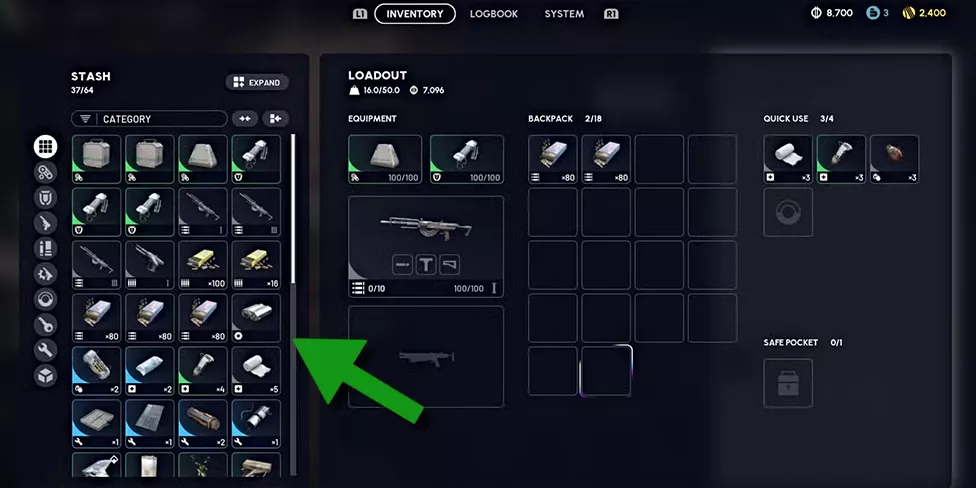
Sell turns an item into Coins in Speranza. Recycle converts it into the materials shown by the item menu. During a raid, Field Recycling (often described as salvaging) can turn an item into components and free inventory space, but it may yield fewer or different materials than full recycling back home. Always check the preview for that specific item.
| Option | Where | Choose It When |
|---|---|---|
| Sell | Speranza | You need Coins more than the item’s possible parts or utility |
| Recycle | Speranza | The displayed components advance an active craft or repair |
| Field Recycling / Salvage | Topside | Freeing space or getting emergency materials matters more than the full return |
| Field Crafting | Topside | You can turn found ingredients into a useful item during the raid |
Do not field-recycle everything that looks cheap. A bulky item may contain the exact Processors, Steel Springs, or other components you need later, and converting it during the raid can produce a different result. The correct calculation is useful materials from conversion versus Coins from sale versus the cost of keeping the item. See Advanced Crafting Chains for the exact recipe-side dependencies.
Scrappy Is a Material Buffer, Not a Coins Printer
Scrappy collects basic supplies such as Metal Parts, Fabric, Plastic Parts, Chemicals, Rubber Parts and Assorted Seeds while you are Topside. He does not generate materials simply because the game is closed or your character is standing in Speranza. These resources can lower your regular kit costs, and any excess may be useful economically, but his actual value depends on which materials you use.
Collection scales with the time you personally spend in a raid up to a cap rather than growing without limit for an entire long match. Check the collection box after runs and improve Scrappy’s level when his output aligns with your everyday crafting needs. Do not budget for the old claim of a guaranteed “3,000-5,000 Coins per run” or assume his parts replace farming specialized rare materials.
Spend Coins Where They Prevent Your Next Loss
Profit is only half the loop. The other half is keeping enough working capital to raid. Prioritize by your current bottleneck rather than buying everything as soon as you can afford it.
| Your Situation | Best First Expense | What Can Wait |
|---|---|---|
| You regularly go broke after losing a kit | Reliable replacement weapons, healing, ammo and modest reserves | Luxury attachments and expensive Stash tiers |
| You have Coins but cannot craft a needed item | The exact missing component or Workshop level | More duplicate gear that uses the same scarce material |
| You are losing Coins through broken equipment | Compare repair preview with crafting or replacing the item | Repairing every low-value duplicate automatically |
| You cannot store the gear from successful raids | Clear surplus, merge stacks, then consider a Stash upgrade | Speculative long-term hoarding |
For a weapon, compare the repair cost with what a replacement requires in Coins, materials, blueprint access and time. High-tier or Amplified gear can have specialized repair inputs; do not use an old pre-Frozen Trail recipe to decide. A Free Loadout is useful when rebuilding from a loss because it reduces your entry cost, but it is not necessarily the right kit for a difficult objective or a high-value extraction.
Fix the Material or Workshop Blocker
Coins are useful, but a missing component or a station that cannot craft the item may be the actual bottleneck. Choose the smallest next step that resolves it.
Safe Pocket and Extraction: Protect the Real Bottleneck
Your valuable loot only helps if you keep it. When choosing the Safe Pocket, favor an item that is unusually difficult to replace: an unlearned blueprint, a key needed for your current plan, a scarce upgrade component or a high-value collectible. Check item eligibility and pocket limits before you rely on protection.
Free Loadout trade-off: a Free Loadout costs less to risk, but it does not provide a Safe Pocket. If your goal is to preserve an unlearned blueprint or a hard-to-replace project item, consider an appropriate Augment rather than taking a free kit just to save Coins.
For a normal Coin run, decide on an exit while your bag is still mostly empty. Once it contains enough valuables to pay for the next kit or Stash goal, another container has to justify both the detour and the increased chance of losing the unprotected haul. If the target building is contested, take a smaller success over a hypothetical perfect bag.
Some maps and Map Conditions change the practical exits and risks. Check the extraction options rather than assuming the same lift, hatch or gondola is always available.
ARC Raiders Economy FAQ
What is the fastest way to get Coins in ARC Raiders?
Extract consistently with trinkets and other sellable loot, then sell items that are not required for your current upgrades. Short, familiar routes usually beat a long run that ends with a lost backpack.
What should I sell first when my Stash is full?
Start with pure valuables you no longer need and unused duplicate weapons or attachments. Keep the exact number of components required for active Workshop, Outpost and quest objectives.
Are Lance’s Mixtape and the Snow Globe worth selling?
They are valuable trinkets, commonly listed at 10,000 and 7,000 Coins respectively. Sell them when they are not needed for your current projects or any other specific use.
Does Scrappy generate Coins while I am offline?
No. Scrappy gathers basic materials and Seeds while you spend time Topside. Those materials can reduce your gear costs, but they are not a fixed offline Coin payout.
Is Cred still used for progression?
No. Frozen Trail 2.0 removed Cred and introduced Reward Points for the selected Reward Pass. Coins continue to serve the everyday purchasing economy.
What is the maximum Stash size after Frozen Trail?
The standard Stash reaches 328 slots with its regular upgrades. This does not include eligible additional space from Expedition or Nomadic Envoy systems. Check the in-game Expand cost before purchasing a tier.
Is recycling always better than selling?
No. Recycle when the materials are worth more to your current craft than the Coins you would receive. A pure trinket normally belongs in the sale pile; a useful electronic item may be worth recycling.
Should I salvage items during a raid?
Use Field Recycling when space or immediate components matter enough to justify it. The output may differ from full recycling in Speranza, so inspect the conversion first.
Should I repair or replace my damaged weapon?
Check the actual repair materials, replacement recipe, blueprint availability and vendor options. Repair scarce, upgraded gear when that costs less than replacing it; do not repair every spare just because it is damaged.
Which map is best for money farming?
The best choice is a familiar map with enough valuable loot and a reasonable exit. Buried City can be strong for valuables, Spaceport for valuable technical recyclables, and Riven Tides has improved overall loot value. Pendola Pass rewards flexible routing because its Dynamic Loot Zones change value between raids.
After Every Raid: A 60-Second Economy Check
- Secure the item needed for your nearest quest, craft or upgrade.
- Combine partial stacks and move ready-to-use gear into your working kit reserve.
- Sell trinkets and surplus items with no active purpose.
- Recycle only after checking the actual component output.
- Keep enough Coins or materials for the next raid before spending on storage or luxury gear.
For most players, that short routine has a bigger impact than memorizing every collectible price. The goal is to turn a successful extraction into another useful raid, not just a larger number beside your Coins.
Game state: Frozen Trail Update 2.2, October 2026. Coin prices, merchant rotations and item requirements may change; inspect current in-game values before committing resources.