
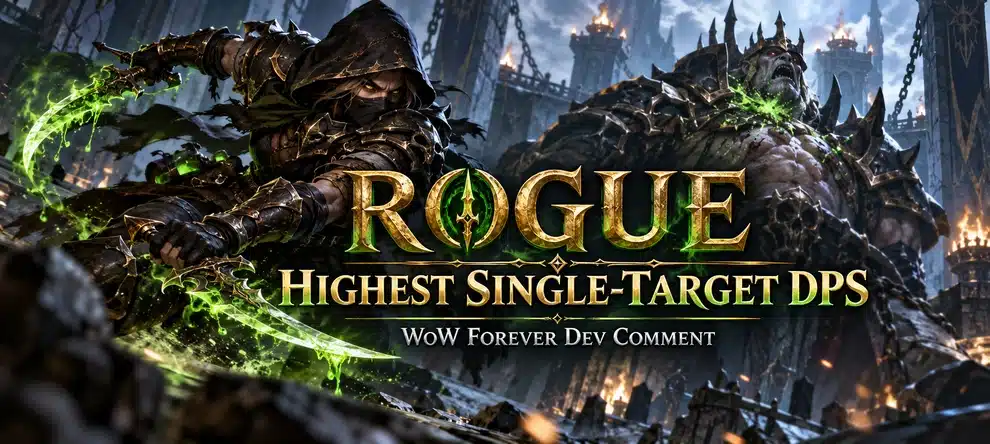
Blizzard has given Rogues one of the clearest class-design promises we have heard so far for World of Warcraft: Forever: in a pure single-target boss encounter, Rogue is intended to sit at the top of the damage meter.
During WoW: Forever Podcast Episode 2, Principal Game Designer Kris Zierhut explained that Rogues are being designed to deliver the highest single-target damage when they can stay on a boss and continuously attack it.
That does not mean Rogue is guaranteed to be the best DPS class on every encounter. Zierhut specifically framed the comparison around a largely stationary, Patchwerk-style fight where mechanics do not heavily interrupt the Rogue’s uptime.
WoW Forever Rogue Single-Target Damage — Quick Facts
What Blizzard Actually Said About Rogue Damage
The comment came during Blizzard’s second official WoW: Forever Podcast, which focused on class design. The episode featured Senior Game Designers Josh “Aggrend” Greenfield and Aidan Moon, Principal Game Designer Kris Zierhut, and Sodapoppin.
While discussing Rogue balance, Zierhut explained that the class can be difficult to tune because a large amount of its damage comes from several systems working simultaneously: normal weapon attacks, Slice and Dice, and Poisons.
That combination can make Rogue damage climb very quickly when tuning changes improve several parts of the package at the same time.
Despite that risk, Zierhut gave PvE Rogue players an unusually direct reassurance: under the right encounter conditions, Rogues are intended to be the highest single-target damage dealers.
He then summarized the design philosophy with an even more revealing question: if Rogue is not exceptional at single-target damage, what is the reason to bring one?
This tells us more than simply “Rogue damage is high.” Blizzard appears to be treating single-target damage as part of Rogue’s class identity and raid value.
“Highest Single-Target” Does Not Mean Highest DPS Everywhere
The encounter qualification matters.
Zierhut described something close to a traditional Patchwerk-style fight: one boss, limited movement, minimal target switching, and enough uninterrupted melee uptime for Rogue to maintain its full damage cycle.
That is close to the perfect environment for the class.
| Encounter Type | What the Developer Statement Tells Us |
|---|---|
| Single Boss / Standstill | Rogue is intended to be one of the strongest classes and, according to Zierhut, the highest single-target damage dealer. |
| Heavy Movement | The statement does not guarantee Rogue will remain on top if melee uptime is repeatedly lost. |
| Frequent Target Switching | Rogue performance will depend on how efficiently Energy, Combo Points, Poisons, and finishers transfer into the new target. |
| Cleave | Combat can gain significant value from Blade Flurry, but Blizzard did not say Rogue should dominate all cleave encounters. |
| Large AoE | No developer promise was made that Rogue should lead large-area damage. |
| PvP | Zierhut specifically framed the reassurance toward PvE Rogue players, not PvP balance. |
This distinction will matter once Warcraft Logs-style raid data becomes available. A Rogue could have the game’s strongest theoretical single-target profile while another class finishes above it on a specific encounter because that fight rewards ranged uptime, adds, cleave, burst windows, or another mechanic.
Why Rogue Can Be So Strong on One Target
Zierhut’s explanation points toward the way Rogue damage compounds during uninterrupted melee uptime.
Auto-attacks continue dealing damage while Energy regenerates. Slice and Dice increases the rate of those attacks. Poisons add another damage layer, and Forever gives Rogue additional interactions through its redesigned talent trees.
The result is a class that benefits enormously from simply being allowed to remain behind or beside one target and continue attacking.
That makes lost uptime especially important. Every second spent outside melee range can mean fewer weapon swings, fewer Poison opportunities, less Combo Point generation, and fewer finishers over the full encounter.
In other words, Blizzard’s intended Rogue strength and Rogue’s traditional weakness are connected: extremely high damage while connected to the target, but a much greater penalty when mechanics prevent that connection.
What This Means for Assassination Rogue
Assassination Rogue is the easiest specialization to associate with this announcement because Forever gives it a much stronger dedicated single-target and Poison identity.
The deeper tree revolves around Mutilate, Seal Fate, improved Poisons, and Venom.
Mutilate attacks with both weapons and gains additional damage against Poisoned targets. Seal Fate accelerates Combo Point generation through critical strikes, while Venom turns those Combo Points into a stronger Poison window.
That creates a natural sustained boss-damage cycle:
- Keep the target Poisoned.
- Generate Combo Points efficiently through Mutilate and critical strikes.
- Maintain Slice and Dice where the encounter duration rewards it.
- Maintain the Poison-focused Venom window.
- Convert remaining Combo Points into damaging finishers.
However, Blizzard did not say that Assassination will be the highest Rogue specialization at level 60.
The current 36/13/2 Assassination PvE build in our guide remains level-60 theorycraft. Real raid testing, weapon availability, Poison tuning, resistances, and later beta changes can still move the final numbers significantly.
What This Means for Combat Rogue
Combat Rogue may fit Zierhut’s description even more literally.
Combat builds heavily around sustained weapon damage, dual wielding, Slice and Dice, Hack and Slash, Adrenaline Rush, and repeated use of damaging finishers.
That makes a stationary boss exactly the type of target where Combat can keep its entire damage engine running with minimal interruption.
The specialization also has an important advantage that complicates the “single-target only” discussion: Blade Flurry allows melee attacks to strike an additional nearby opponent for a limited window.
Combat therefore has a route from very strong sustained boss damage into two-target pressure that Assassination may not reproduce in exactly the same way.
Our current Combat PvE theorycraft uses an 18/33/0 direction built around the full Combat package with Assassination support, but Blizzard has not confirmed that this will be the final top Rogue raid build.
What This Means for Subtlety Rogue
Subtlety Rogue is the most interesting unknown.
Classic Subtlety was much more closely associated with Stealth, control, openers, and PvP than sustained raid damage. WoW Forever is deliberately trying to give the specialization a more complete PvE loop.
Hemorrhage now increases the Rogue’s own Rupture damage, while Serrated Blades and Thousand Cuts push the tree toward sustained bleed gameplay.
This means Blizzard is no longer designing Subtlety as a tree that only matters for openers and PvP utility.
Whether that new Rupture cycle can compete with Assassination’s Poison engine or Combat’s sustained weapon damage remains one of the more interesting unanswered Rogue questions.
Blizzard Has Not Named the Best Rogue Spec
This is the most important limitation to keep in mind.
Zierhut talked about Rogue as a class. He did not say:
- Assassination will be the highest DPS specialization.
- Combat will be the highest DPS specialization.
- Subtlety will be the highest DPS specialization.
- Every Rogue spec will produce identical single-target damage.
Those are completely different claims.
Blizzard can preserve Rogue’s class-wide single-target identity while still allowing one Rogue specialization to perform better than another in a specific raid tier.
That is why our individual Rogue spec guides still treat the complete level-60 PvE setups as theorycraft rather than final rankings.
You can compare all three talent trees and their current build directions in the WoW Forever Rogue Talent Calculator.
Could Raids Start Stacking Rogues?
That was one of the first concerns raised by players after the developer comment appeared.
If one class is intentionally tuned to win a perfect single-target damage race, players naturally start asking whether optimized raids will simply bring more of that class.
The concern is understandable, particularly in a Classic-style environment where players have historically optimized raid compositions aggressively once a numerical advantage becomes well established.
But Zierhut’s encounter qualification makes it too early to draw that conclusion.
Raid composition does not depend only on theoretical Patchwerk DPS. Actual encounters can reward:
- AoE damage;
- cleave;
- ranged uptime;
- burst during specific mechanics;
- interrupt coverage;
- crowd control;
- defensive utility;
- survivability;
- movement;
- target switching.
A Rogue advantage on a stationary single target therefore does not automatically translate into the ideal answer for every raid slot.
The Community Reaction Is Already Split
The statement immediately produced two very different reactions.
One side argues that the design makes sense. Rogue is a pure melee damage class without the tanking or healing flexibility of a hybrid, and its large-scale AoE toolkit is more limited than some alternatives. From that perspective, exceptional single-target damage gives the class a clear reason to exist in a raid.
The other side is concerned that explicitly designing one class to lead single-target damage could encourage class stacking or make competing melee DPS feel inferior on straightforward boss fights.
There is also an important timing element here. Rogue players had already been debating the class’s current beta tuning, including several talent reductions and uncertainty around the new Assassination and Subtlety directions.
The developer statement therefore acts as a useful signal about Blizzard’s destination, not necessarily a description of where every Rogue build sits in the beta today.
This Comment Matters More Than a Temporary DPS Ranking
Beta damage rankings can change from build to build. A talent coefficient can be adjusted, a Poison can be retuned, or a weapon interaction can move a specialization several positions overnight.
A developer statement about class identity is more useful.
Blizzard is effectively telling Rogue players what the team expects the class to be good at when tuning approaches its intended destination:
Put a Rogue on one target, allow the Rogue to stay connected, and that sustained single-target damage should be exceptional.
That gives us a much stronger framework for evaluating future Rogue changes.
If a new beta build significantly reduces Rogue single-target performance, the important question is no longer simply whether the class was nerfed. We can compare those changes with Blizzard’s stated goal and ask whether the complete package still supports that intended role.
Where Each WoW Forever Rogue Spec Currently Fits
| Rogue Spec | Current Forever Identity | What to Watch | Guide |
|---|---|---|---|
| Assassination | Poisons, Mutilate, fast Combo Points, Venom | How strong the full Poison engine becomes on long single-target fights | Assassination Rogue Guide |
| Combat | Sustained weapon damage, Slice and Dice, Hack and Slash, cooldown cycling | Whether consistent weapon damage becomes the strongest Patchwerk-style setup | Combat Rogue Guide |
| Subtlety | Stealth, control, Hemorrhage, Rupture, Thousand Cuts | Whether the redesigned bleed loop can support competitive sustained PvE damage | Subtlety Rogue Guide |
Planning to Play Rogue in WoW Forever?
If this developer direction makes you consider Rogue for launch, start with our complete WoW Forever Rogue Guide.
It explains the class-wide changes to Energy, Combo Points, Poisons, weapons, Stealth, races, and specialization identities without forcing you to choose a spec first.
Once you know which Rogue style you want, continue with the relevant specialization guide:
- WoW Forever Assassination Rogue Guide — Mutilate, Venom, Poisons, PvE and PvP builds.
- WoW Forever Combat Rogue Guide — sustained weapon damage, Hack and Slash, Blade Flurry, Adrenaline Rush.
- WoW Forever Subtlety Rogue Guide — Hemorrhage, Rupture, Thousand Cuts, Stealth and control.
Then use the WoW Forever Rogue Talent Calculator to compare the current Assassination, Combat, and Subtlety talent layouts directly.
Rogue Finally Has a Clear PvE Promise
There are still many unanswered questions about level-60 balance in WoW Forever, but Rogue now has something most classes do not: an unusually explicit statement from one of Blizzard’s principal designers about where the class should excel.
In an ideal single-target boss encounter, Rogue is intended to be at the top.
The important words are still ideal and single-target.
Movement, cleave, AoE, target switching, raid utility, encounter mechanics, tuning changes, and specialization balance can all change what the final damage meter looks like.
But the underlying design direction is much clearer now.
WoW Forever Rogues are not being built merely as Stealth and control specialists. Blizzard wants sustained boss damage to be one of the primary reasons a raid brings them.


