
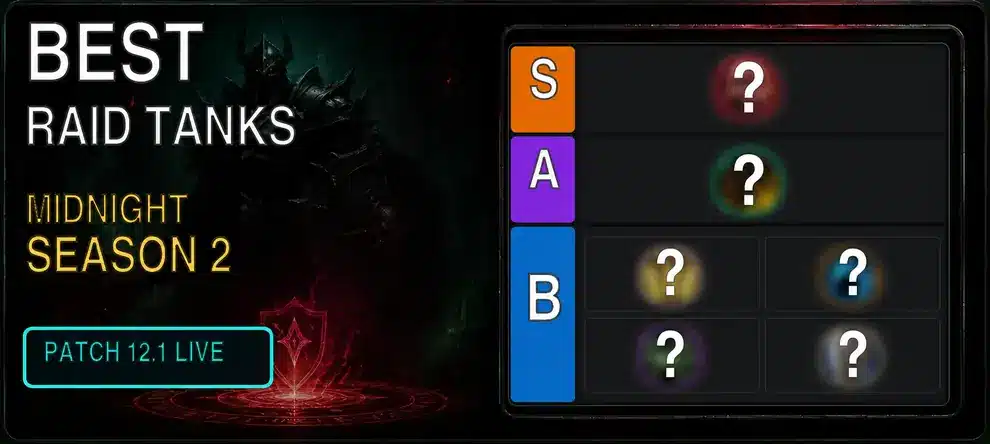
Best raid tanks in WoW Midnight Season 2 (Patch 12.1.5): Blood Death Knight and Protection Paladin are the S-tier choices in the expert progression assessment we use for our season-wide raid rankings. Guardian Druid, Brewmaster Monk and Protection Warrior are A tier; Vengeance Demon Hunter is B tier. Every one of the six tanks can clear Mythic raid content, and an experienced B-tier player is usually a better option than a poorly prepared reroll.
This guide covers both The Venomous Abyss and The Unbinding of Kith’ix. It also includes practical tank assignments for The Tidebound Grotto, a separate Lair encounter whose higher difficulties can count toward the Great Vault raid row. Tank tiers are a starting point for raid composition, not a newly calculated average of every boss log. For Kith’ix in particular, swap timing and add placement are more important than finding a new S-tier tank.
Reviewed: October 17, 2026. Live content: Midnight Season 2, Patch 12.1.5. Primary tier baseline: Icy Veins raid tank assessment, with its main order dating to August 29 and an additional 12.1.5 encounter note. This differs from Wowhead’s October 12 tank raid assessment. We describe that difference below rather than presenting the older baseline as a newly measured October tank-log ranking.
WoW Midnight Season 2 Best Raid Tank Tier List (12.1.5)
| Tier | Specializations | Reason to Bring Them |
|---|---|---|
| S | Blood Death Knight, Protection Paladin | Strong progression assignments: Death Grip and self-recovery from Blood; Blessings, external saves and Devotion Aura from Protection. |
| A | Guardian Druid, Brewmaster Monk, Protection Warrior | Dependable boss tanking, raid buffs or unique mitigation. Their value rises when your roster lacks a Druid, Monk or Warrior. |
| B | Vengeance Demon Hunter | Excellent mobility and Chaos Brand, with talent and mitigation tradeoffs in the chosen raid-specific expert baseline. |
Reading the letters: these are overall raid-progression judgments, not an item-level requirement, a guarantee of highest DPS, or a claim that Vengeance cannot tank Mythic. The baseline mainly evaluates Venomous Abyss. New Kith’ix tank mechanics are discussed separately rather than used to invent a second list. See our complete Season 2 Raid Class Tier List for the same tank groups alongside DPS and healer rankings.
Which Raid Tank Should You Play?
| Your Raid Need | Practical Tank Choice | Main Decision |
|---|---|---|
| Pull enemies into a safe location | Blood Death Knight | Are the important adds grippable and do you need Anti-Magic Zone? |
| Cover external saves and key interrupts | Protection Paladin | Can Blessings or Avenger’s Shield solve a real assignment? |
| Steady boss tanking without a complicated control job | Guardian Druid | Is Mark of the Wild missing, and is the current player comfortable with Guardian? |
| Bring Mystic Touch without a DPS or healing Monk | Brewmaster Monk | Can healers support its damage profile and Stagger management? |
| Blockable physical damage and extra raid defense | Protection Warrior | Are Rallying Cry and Battle Shout missing from your group? |
| Long movement assignments or missing Chaos Brand | Vengeance Demon Hunter | Is this mobility worth more than the overall tier difference? |
Raid tank slots are limited. Before replacing a player, check who already provides Devotion Aura, Mystic Touch, Chaos Brand, Mark of the Wild and Battle Shout. Some groups gain more from covering a missing debuff than from exchanging one capable tank for another with a higher letter grade. The two tanks also need to agree on swaps, positioning and personal cooldown coverage.
What Changed Since the September Raid Tank Rankings?
Our previous version was a September 4 snapshot for Patch 12.1. It used a different source and put Blood DK alone in S, Protection Paladin, Guardian and Vengeance in A, and Brewmaster and Protection Warrior in B. This article now follows the same Icy Veins baseline as our updated Season 2 Raid Class guide. That source choice explains several letter changes; it does not prove that Vengeance was nerfed or Brewmaster was buffed in Patch 12.1.5.
| Tank | Previous LepreStore Grade | Current Shared Grade |
|---|---|---|
| Blood Death Knight | S | S |
| Protection Paladin | A | S |
| Guardian Druid | A | A |
| Brewmaster Monk | B | A |
| Protection Warrior | B | A |
| Vengeance Demon Hunter | A | B |
Why two respected rankings disagree: the October 12 Wowhead list still puts Blood alone in S, Protection Paladin and Guardian in A, and Vengeance, Brewmaster and Protection Warrior in B. Icy Veins weighs raid utility and roster fit differently and is the source behind our shared S/A/B classification. Do not mix its tier letters with Wowhead’s in the same table or describe either as an objective all-boss log average.
Confirmed Patch 12.1.5 Tank Changes
Blizzard’s 12.1.5 content notes include a targeted Protection Warrior change: Execute damage increased by 30%, and the Colossus talent Practiced Strikes now also reduces the Rage cost of Execute and Revenge by 10. These changes improve those actions and Rage efficiency; they do not establish a new all-raid ranking on their own. The primary structural shift in 12.1.5 is Kith’ix’s arrival, not a complete rework of every tank.
Earlier Season 2 adjustments also matter. Blood received defensive and damage changes during the 12.1 cycle; Brewmaster gained Celestial Brew and Celestial Infusion absorb improvements; Protection Paladin saw damage increases and a Twin Fangs Mastery bug fix; Vengeance gained defensive tuning across August and early September. Those changes are already part of the season’s background. A fresh guide should explain their current effects without recycling old tuning percentages as if they were applied this week.
Best Raid Tanks: Strengths, Weaknesses and Raid Utility
Blood Death Knight: Grips, Control and Self-Recovery
Blood remains the clearest first tank to consider for progression because it can solve problems that damage meters barely capture. Death Grip and Gorefiend’s Grasp can organize eligible enemies so damage dealers spend less time chasing targets. Anti-Magic Zone gives the raid another response to magical pressure, while a well-managed Death Strike helps Blood recover after heavy hits.
The catch is resource discipline. Blood can appear nearly immortal in one pull and fall over in the next if Runic Power, Bone Shield or cooldown timing are mishandled. Low mobility also matters on spread assignments. Pick Blood when the player is comfortable managing those resources and the fight rewards controlled positioning, not just because the letter says S.
Best fit: high-end progression, grip jobs, raid magic mitigation and groups that value tank self-recovery. Tradeoff: punishing resource mistakes and weaker mobility.
Protection Paladin: External Defensives and Flexible Support
Protection Paladin shares S tier in our chosen baseline because of what its toolkit can do for a full raid. Devotion Aura is a straightforward defensive benefit, while Blessing of Protection and Blessing of Spellwarding can cover certain targeted dangers. Avenger’s Shield is valuable when a mechanic requires additional interrupts rather than brute-force survival.
That utility is encounter- and roster-dependent. If a Holy Paladin already supplies Devotion Aura and your raid never needs an extra Blessing, the value of choosing Protection specifically becomes smaller. On Mythic The Twin Fangs, repeat interrupt assignments provide a clearer reason to want Protection Paladin. Its tier is strong, but those specific jobs explain the recommendation better than a generic promise that it is always the tankiest spec.
Best fit: coordinated progression, Blessing assignments, Twin Fangs interrupts and raids needing a Paladin. Tradeoff: part of its utility can overlap with another Paladin.
Guardian Druid: Consistent Defenses and Simple Assignments
Guardian is an appealing A-tier choice for players who want a dependable defensive routine without sacrificing useful damage. Its kit handles steady pressure well, and Mark of the Wild helps the entire raid if the roster lacks another Druid. Guardian is also easy to pair with a more specialized utility tank such as Protection Paladin.
Its biggest roster issue is duplication. Balance Druid and Restoration Druid are already attractive in this season’s raid content, so Mark of the Wild may be covered before tank selection begins. In that case, choose Guardian for a practiced player and good defensive execution, not just for the buff icon.
Best fit: progression groups that want predictable tanking, flexible pairings and consistent boss damage. Tradeoff: a common raid buff is often supplied elsewhere.
Brewmaster Monk: Stagger and Mystic Touch
Brewmaster’s raid value is partly defensive and partly strategic. Stagger spreads incoming physical damage over time; managing Purifying Brew and Celestial Brew well can make a dangerous sequence easier for healers to plan around. Mystic Touch is an important physical-damage debuff for a raid without another Monk.
That does not make Brewmaster the universally easiest tank to heal. It often wants dependable external healing and an experienced player who knows when to purify, when to hold defensives and when to avoid chasing damage. Windwalker Monk is an A-tier DPS option in our current raid guide, so Mystic Touch may already be accounted for. The A grade here reflects the chosen expert roster baseline, not a claim that every Brewmaster log is stronger than Vengeance’s.
Best fit: rosters missing Mystic Touch, players comfortable with Stagger management and groups that coordinate tank healing. Tradeoff: healer dependence and overlap with another Monk.
Protection Warrior: Physical Mitigation and Rallying Cry
Protection Warrior is a capable A-tier raid option in our selected baseline. It has strong tools for blockable physical damage, including Shield Block and Ignore Pain, with additional defensive cooldowns for planned bursts. Rallying Cry is a useful raid-wide safety net and Battle Shout can fill a roster gap when no DPS Warrior is present.
Its weak points are more specific than the old B-tier label implied. Repeated damage-over-time effects and heavy unblockable damage demand careful planning. The October Execute and Practiced Strikes changes improve portions of Colossus’s rotation and Rage economy, but should not be described as a wholesale defensive redesign. Warrior is a solid choice when the encounter fits its mitigation pattern and the player knows the timing.
Best fit: blockable boss attacks, extra Rallying Cry coverage and groups lacking Battle Shout. Tradeoff: less comfortable damage profiles when attacks bypass its usual defenses.
Vengeance Demon Hunter: Mobility, Chaos Brand and Raid Fit
Vengeance sits in B tier in the Icy Veins raid model used by this site, but that is not a verdict on its ability to clear Mythic. Its movement toolkit is especially helpful on bosses where the tank must quickly cross the room without slowing a mechanic. Chaos Brand adds important group damage value if your raid lacks a Havoc or Devourer Demon Hunter.
The tradeoff is between damage, defensive consistency and the utility choices in the talent tree. Vengeance received defensive improvements during the season, and Wowhead’s current progression model still differs in its interpretation of the tank’s place. If your best tank player is on Vengeance and performs positioning assignments reliably, a theoretical letter gap is usually not worth a rushed reroll.
Best fit: movement-heavy assignments and missing Chaos Brand. Tradeoff: defensive/offensive talent tension and lower general roster value in the chosen source.
Best Tank Choices Across All Midnight Season 2 Raid Content
The Venomous Abyss: Eight Bosses, Different Tank Jobs
The Venomous Abyss is the primary eight-boss raid behind most of the season’s tank-ranking evidence. A tank pair should be chosen for the bosses still blocking your progression, not for a theoretical perfect composition on every encounter. Our Venomous Abyss raid guide owns the detailed raid overview and loot; the table below focuses on what changes tank selection.
| Boss | Practical Tank Priority |
|---|---|
| Nek’zali the Soulcoiler | Control enemies and keep a repeatable positioning plan. Grips can be valuable when the target is eligible. |
| Entombed Sentinels | Clean two-tank coordination and defensive timing matter more than a class-specific shortcut. |
| The Lost Explorers | Plan which tank controls which active target. Keep disruptive enemies separated when the encounter calls for it. |
| Vashnik the Malignant | Use consistent defensive assignments; there is no reason to reroll solely for this boss. |
| Sszorak | Movement-heavy tasks reward Vengeance mobility when the group needs fast repositioning. |
| The Twin Fangs | Protection Paladin’s Avenger’s Shield can assist demanding interrupt coverage, especially on Mythic. |
| The Coiled Altar | Positioning and movement make Vengeance attractive; Guardian can pair well with a utility tank. |
| Ula’tek | Reliable survival and eligible add control are important. Blood DK has a particularly strong progression use case. |
None of these encounter notes means that a named tank is mandatory. A reliable player who already knows the assignment can outperform a theoretically favorable class that misses swaps or drags the boss into the raid.
The Unbinding of Kith’ix: Dark Devastation, Adds and Negation
Kith’ix is a new single-boss raid added in Patch 12.1.5, not another eight-boss clear. The encounter tests a tank pair’s communication and movement more than it asks for a special class. Icy Veins’ encounter guide and Wowhead’s boss strategy describe the main tank duties:
| Phase | Tank Assignment | What Can Go Wrong |
|---|---|---|
| Phase 1 and add waves | One tank controls Kith’ix at the edge while the other gathers Venomous Hulk away from the boss; keep dangerous adds on the kill target. | Uncontrolled enemies reach the raid or the boss gets dragged into the add stack. |
| Dark Devastation | Move the marked tank circle away from allies and swap when the Devastated debuff is applied. | A delayed taunt or poorly placed circle damages teammates and complicates the next position. |
| Liadrin intermission | Stay safely inside the protective area while controlling remaining enemies and the Dark Devastation circle. | Leftover adds and bad positioning put too much pressure on the group. |
| Final 25% phase | Swap on Negation, use a defensive, and route through a Null Gate to clear the debuff before it becomes lethal. | Missed swap, late Gate route or unnecessary Nullshard stacks during the burn. |
Blood DK can assist with grippable adds; Protection Paladin can bring external saves. Guardian, Brewmaster, Warrior and Vengeance can still tank the encounter. Learn the swaps and plan defensive uptime before changing the roster. The fight’s last phase is a time-limited DPS push, so tank reliability is especially valuable: an avoidable late tank death often wastes the entire attempt.
Tidebound Grotto Lair: Nymrissa Wavecaller
Tidebound Grotto is a standalone Lair, not a third multi-boss raid. Nymrissa Wavecaller has World, Normal, Heroic and flexible Mythic difficulties, and the encounter can contribute to the Great Vault raid row. The tank must keep Water Jet pointed away from the group, manage its sustained damage and coordinate around Alluring Bubble, incoming murlocs and Swirling Whirlpools.
On Mythic, the Water Jet interaction can be used to clear Lingering Frost patches, so positioning has a direct effect on the usable arena. Follow the detailed Nymrissa Wavecaller guide rather than improvising that mechanic. This fight rewards clean communication and smart hazard placement; it does not provide evidence for a new overall tank ranking.
Need a Kith'ix Clear, a Lair Run, or a Better Gear Route?
Now that you know the difference between the season’s raid encounters, choose a specific next step. A Kith’ix boss kill, a Nymrissa Lair clear and gearing your own tank solve different problems.
Best Raid Tank Pair: Cover Assignments, Not Just Tier Letters
The strongest pair changes with encounter mechanics and the rest of the raid. For a progression group choosing between equally experienced players, these combinations illustrate different strengths:
| Tank Pair | Reason to Consider It | Check Before Locking It In |
|---|---|---|
| Blood DK + Protection Paladin | Grips, magic-damage response, Blessings and flexible raid support. | Is the player on Blood comfortable with resource management? Do you already have a Paladin for Aura? |
| Blood DK + Guardian Druid | Strong self-recovery beside a straightforward defensive partner. | Does Mark of the Wild add anything to the roster? Which player handles fast movement? |
| Protection Paladin + Brewmaster Monk | External saves and Mystic Touch for a roster without another Monk. | Can your healers support Brewmaster’s damage pattern? |
| Protection Warrior + Vengeance DH | Rallying Cry, physical mitigation and mobility for special assignments. | Are both tanks experienced, and do you have the needed cooldowns for magical pressure? |
These are examples, not mandatory meta pairs. A guild should keep two practiced tanks whenever possible and solve missing buffs through the wider roster. If a specific mechanic is failing, review logs and assignments before treating the group composition as the problem.
What Warcraft Logs Can and Cannot Tell You About Tanks
Tank performance is more than a damage number. A faster kill can increase a tank’s DPS parse while reducing how long it must survive. A player assigned to move adds or hold a boss away from the raid may log less damage than someone with constant uptime. Aggressive offensive talents can also make DPS look better while increasing healer strain.
For useful comparisons, inspect Warcraft Logs for boss-specific damage intake, defensive casts, deaths and positioning alongside DPS. Compare similar difficulties and similar kill lengths. Use Archon for usage and build context, but avoid copying an old parse count into a supposedly live snapshot. Neither data source alone can price the value of a well-timed Blessing, a grip assignment or a stable taunt swap.
Are Raid Tanks and Mythic+ Tanks Ranked the Same?
No. Raid tanking weighs scripted boss survival, raid buffs, planned tank swaps and how you deal with a dangerous add at a specific moment. Mythic+ repeatedly tests route speed, AoE control, interrupts, pulls and mitigation over an entire dungeon. Vengeance movement or a Paladin’s party tools may be more valuable in a dungeon than in a specific raid boss fight; the reverse can be true for Blood’s raid grips or external cooldown coverage.
Our Midnight Season 2 Mythic+ Class Tier List owns that dungeon-specific question. If you only maintain one tank for both raid and keys, weigh the content you actually run and your comfort with the spec rather than applying this raid order to every activity.
Midnight Season 2 Raid Tank FAQ
What is the best raid tank in Patch 12.1.5?
Blood Death Knight and Protection Paladin are S tier in the Icy Veins-based progression assessment used here. Blood is especially valuable for grips and self-recovery; Protection Paladin brings Blessings and external saves. Wowhead uses a different method and places only Blood DK in S, so check which source a ranking follows.
Why is Protection Paladin S here but A on Wowhead?
The two sites use different expert judgments, not a shared numerical scoring formula. We use Icy Veins as our consistent all-raid tank baseline across LepreStore’s Season 2 pages, and we disclose Wowhead’s October 12 alternative rather than hiding the difference.
Does Kith’ix require a Blood Death Knight?
No. Blood can help with eligible add grips, but the key tasks are controlling the Venomous Hulk, moving Dark Devastation safely, swapping on Devastated and handling Negation at 25%. A well-coordinated pair from any of the six tank specs can perform those jobs.
Can Protection Warrior and Vengeance Demon Hunter clear Mythic raids?
Yes. Tier placement measures overall progression value in a chosen expert model, not whether a specialization is eligible to finish the content. Practiced cooldown use, gear, positioning and communication matter more than forcing an unfamiliar reroll.
What is the best two-tank composition for Season 2?
Blood Death Knight plus Protection Paladin is a strong general starting point for utility-heavy progression, but no combination is mandatory across every Venomous Abyss and Kith’ix encounter. Use Guardian, Brewmaster, Warrior or Vengeance where player experience or a missing raid buff gives them a stronger practical role.
Is Tidebound Grotto included in these rankings?
Yes, its tank mechanics are included in the encounter advice. Tidebound Grotto is a separate Lair with Nymrissa Wavecaller, not an additional multi-boss raid. Its Water Jet positioning and murloc control do not justify a new cross-season tank tier table.
Should I reroll to an S-tier tank in the middle of Season 2?
Usually not for a one-tier difference. Improve defensive timing, your tank-swap plan, gear and raid assignments first. Consider switching if your team repeatedly lacks a specific tool that another tank can provide and you already know how to play it well.